Contact Us
Overview

SmartDV’s AMBA DTI Verification IP is a comprehensive solution for verifying the Arm Distributed Translation Interface, a scalable point-to-point messaging protocol aligned with the Arm System MMUv3 architecture for address translation services. Fully compliant with the AMBA DTI Protocol Specification Issue J and backward compatible with earlier issues, it supports complete verification of both DTI-TBU, defining communication between Translation Buffer Units and the Translation Control Unit, and DTI-ATS, defining communication between PCIe Root Complexes with Address Translation Services and the Translation Control Unit, across all supported protocol versions including DTI-TBUv5 and DTI-ATSv5.

SmartDV’s AMBA DTI VIP supports UVM, SystemVerilog, and Verilog, and integrates seamlessly into diverse verification environments. It is simulator-independent and compatible with all leading EDA simulators, providing flexibility across simulation platforms.

With support for multistage address translation, cache model verification, MPAM, expanded Physical Address Space support, protected mode attributes, PCIe ATS integration, on-the-fly protocol checking, built-in functional coverage, and a complete test suite, SmartDV’s AMBA DTI VIP enables verification teams to thoroughly validate memory translation subsystem designs for mobile, automotive, AI, data center, and cloud computing SoC applications.
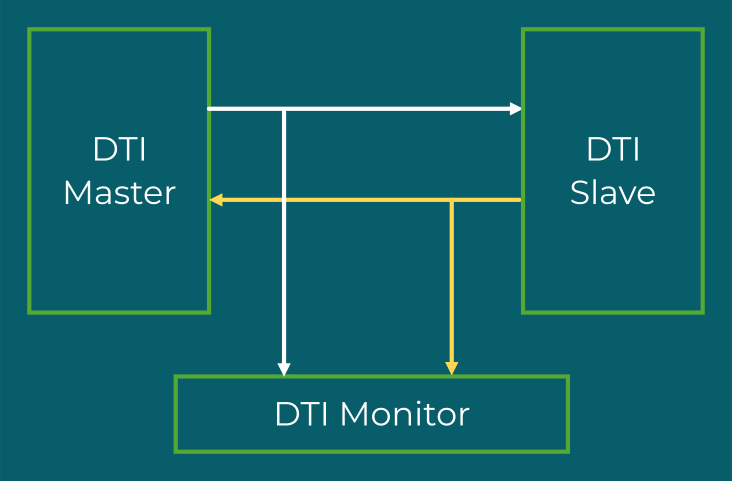
AMBA DTI VIP
Benefits
  • Full DTI Agent Support – Provides TCU, TBU, and ATS agent components for both DTI-TBU and DTI-ATS protocols, supporting all protocol versions through DTI-TBUv5 and DTI-ATSv5 with a rich set of configuration parameters for fine-grain protocol control.
  • Comprehensive Translation Flow Verification – Supports complete address translation flows including configuration lookup, translation table walks, streamID-based Stream table traversal, TBU translation request and response handling, TCU invalidation of cached translations, and direct cache prefetch and destructive read permission verification.
  • Cache Model Support – Provides robust cache model verification for TBU translation caches, configuration caches, and TCU-managed cache invalidation flows, with support for cache state tracking and restoration for new connections to ensure performance and reliability.
  • DTI-H and Latest Protocol Features – Covers protocol version 5.0 features including expanded Physical Address Space support with Non-secure Protected and System Agent address spaces, protected mode attributes for data isolation, streamlined protocol fields, relaxed TCU token grant policies, and translation token width extension to 12 bits for increased outstanding translation requests.
  • PCIe ATS Integration – Supports DTI-ATS protocol for PCIe Root Complex to TCU communication including Address Translation Services request and response flows, ATS invalidation handling, and protocol version 4.0 and 5.0 ATS encoding.
  • Security and Memory Partitioning Support – Covers Memory System Resource Partitioning and Monitoring (MPAM), Realm Management Extension support for Root and Realm Physical Address Spaces, and multiple Physical Address Space configurations for secure, non-secure, root, and realm address spaces.
  • Robust Error Injection and Protocol Checking – Provides on-the-fly protocol and data checking, error injection across all DTI protocol flows, programmable timeout insertion, transaction logging and performance reporting, and notification of significant events including transactions, warnings, and protocol and timing violations.
  • Complete Verification Infrastructure – Provides built-in functional coverage analysis, constraints randomization, status counters for bus events, and callbacks in TCU, TBU, and Monitor agents for user-defined event handling across all DTI protocol conditions.
Compliance and Compatibility
  • Fully compliant with Arm AMBA DTI Protocol Specification Issue J; backward compatible with Issues E through H
  • Supports DTI-TBU and DTI-ATS protocols through protocol versions v1 to v5
  • Compatible with UVM, OVM, VMM, SystemVerilog, and Verilog verification environments
  • Compatible with all major EDA simulators including Synopsys VCS, Cadence Xcelium, Siemens Questa, Aldec Riviera-PRO, and Verilator