Contact Us
Overview

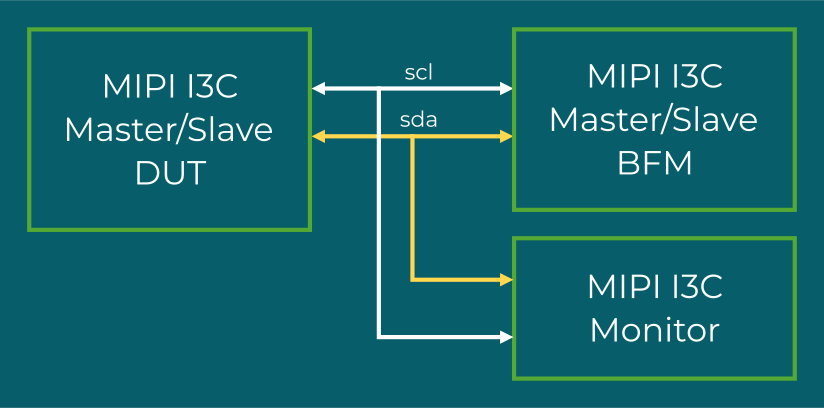
SmartDV’s MIPI I3C Verification IP is a comprehensive solution for verifying the MIPI Improved Inter-Integrated Circuit bus, the successor to I2C providing a unified high-performance, very-low-power two-wire serial interface for sensor, actuator, and system management applications. Fully compliant with MIPI I3C v1.2 and MIPI I3C HCI v1.2, it supports complete verification of I3C controller and target components across all topologies, all SDR and HDR messaging modes including HDR-DDR, HDR-TSL, HDR-TSP, and HDR-BT, multi-lane data transfer in DUAL and QUAD configurations, Device to Device tunneling, all Common Command Codes, and the complete I3C Host Controller Interface with PIO and DMA modes, covering all descriptor types, command rings, and error handling.

SmartDV’s MIPI I3C VIP supports UVM, SystemVerilog, and Verilog, and integrates seamlessly into diverse verification environments. It is simulator-independent and compatible with all leading EDA simulators, providing flexibility across simulation platforms.

With legacy I2C device co-existence, dynamic and static address assignment, in-band interrupt, hot-join, secondary master request support, comprehensive error injection across all defined error types, glitch insertion, bus-accurate timing, built-in functional coverage, and a complete test suite, SmartDV’s MIPI I3C VIP enables verification teams to thoroughly validate I3C bus interface designs for smartphones, IoT devices, automotive ECUs, data center management, industrial sensors, and any application requiring high-performance low-pin-count serial connectivity.
Request Data Sheet
MIPI I3C VIP
Key Features
  • Full I3C Controller and Target Support – Provides complete MIPI I3C controller and target component verification across all four defined topologies including Multi Controller-Multi Target, Multi Controller-Single Target, Single Controller-Multi Target, and Single Controller-Single Target, supporting legacy I2C device co-existence, dynamic address assignment with static addressing for I2C devices, I3C address arbitration, hot-join request, in-band interrupt, and secondary master request.
  • SDR and HDR Messaging CoverageSupports Single Data Rate messaging including I3C SDR coding, SDR with directed CCC addressing, and SDR with broadcast CCC addressing, and all High Data Rate modes including HDR-DDR, HDR-TSL, HDR-TSP, and HDR-BT, with CCC framing in all HDR modes and HDR-DDR ML coding and interoperability for CCCs.
  • Multi-Lane Data Transfer Support – Supports all multi-lane data transfer formats including SDR-ML DUAL and QUAD coding, HDR-DDR-ML DUAL and QUAD coding, HDR-TSP-ML DUAL and QUAD coding, and HDR-BT-ML DUAL and QUAD coding, along with Device to Device tunneling and mixing of various message types.
  • Comprehensive Error Injection and Detection – Supports all defined slave error types S0 through S6 and SM0, master error types M0 through M3, and error injection including master abort, master ACK on last read, master continue after write NACK, glitch injection on clock and data, random and periodic clock period stretching, random write NACK insertion, and CRC and parity errors, along with glitch insertion and detection and I2C 50 ns glitch filter support.
  • I3C HCI PIO Mode CoverageSupports complete MIPI I3C HCI v1.2 PIO interface including Command Queue Operation, Response Queue Operation, and IBI Queue Operation, all descriptor types covering Address Assignment Command, Legacy Immediate and Regular data transfer descriptors, Unified Data Transfer Command, Extra Immediate Data Transfer Command, Internal Control Command, Response Descriptor, IBI Status Descriptor, Secondary Master descriptors, and Combo Transfer Descriptor.
  • I3C HCI DMA Mode CoverageSupports DMA interface with single transfer descriptor defining Command and Data, single response status descriptor for transfer status reporting, linked descriptor support for multicast messaging, Command Rings with multiple Command/Response and IBI Rings including IBI payload, Scatter-Gather, time-stamping, Auto-Command, Scheduled Commands, Global Commands, and Doorbell mechanisms.
  • HCI Advanced Feature SupportSupports predictive addressing scheme, DCT and DAT tables, Data Byte Ordering, interrupt masking, Auto-Reject for IBI and Hot-Join, slave reset and bus recovery, error handling, and all HCI-defined direct commands covering the complete host controller management plane.
  • Complete Verification Infrastructure – Provides a full test suite covering all MIPI I3C v1.2 and I3C HCI v1.2 specification features, built-in functional coverage analysis, bus-accurate timing, and callbacks in controller, target, and monitor for user-defined data processing and protocol and timing violation notification.
Compliance and Compatibility
  • Fully compliant with MIPI I3C v1.2 (February 2025); backward compatible with v1.1.1 and v1.0
  • Compliant with MIPI I3C HCI v1.2 (April 2023)
  • Supports legacy I2C device co-existence on shared bus
  • Supports all SDR and HDR modes including HDR-DDR, HDR-TSL, HDR-TSP, and HDR-BT
  • Supports multi-lane DUAL and QUAD configurations across all transfer modes
  • Compatible with UVM, OVM, VMM, SystemVerilog, and Verilog verification environments
  • Compatible with all major EDA simulators including Synopsys VCS, Cadence Xcelium, Siemens Questa, Aldec Riviera-PRO, and Verilator

Request Datasheet