Contact Us
Overview

SmartDV’s MIPI I3C Synthesizable Transactor is a fully featured MIPI I3C bus model purpose-built for hardware emulation and FPGA prototyping environments requiring fast, accurate, and highly configurable I3C Controller and Target behavior during pre-silicon validation and software bring-up. Fully compliant with MIPI I3C v1.2, it delivers complete Controller and Target functionality across all I3C device types and all standard bus topologies, with legacy I2C device co-existence, giving validation teams a drop-in synthesizable I3C transactor ready for rapid integration into emulation and prototyping flows for mobile, IoT, and automotive peripheral validation.

Designed for the speed and visibility demands of emulation and FPGA prototyping rather than ASIC tape-out, the transactor emphasizes fast bring-up, fine-grained controllability, and on-the-fly protocol checking over area or power optimization. It supports Dynamic Address Assignment, Static Addressing for legacy I2C devices, I3C address arbitration, SDR and HDR-DDR messaging, all Common Command Codes, In-Band Interrupt, Hot-Join, and mixed message type support, enabling validation teams to exercise corner-case I3C behavior that is difficult to reach with production RTL alone.

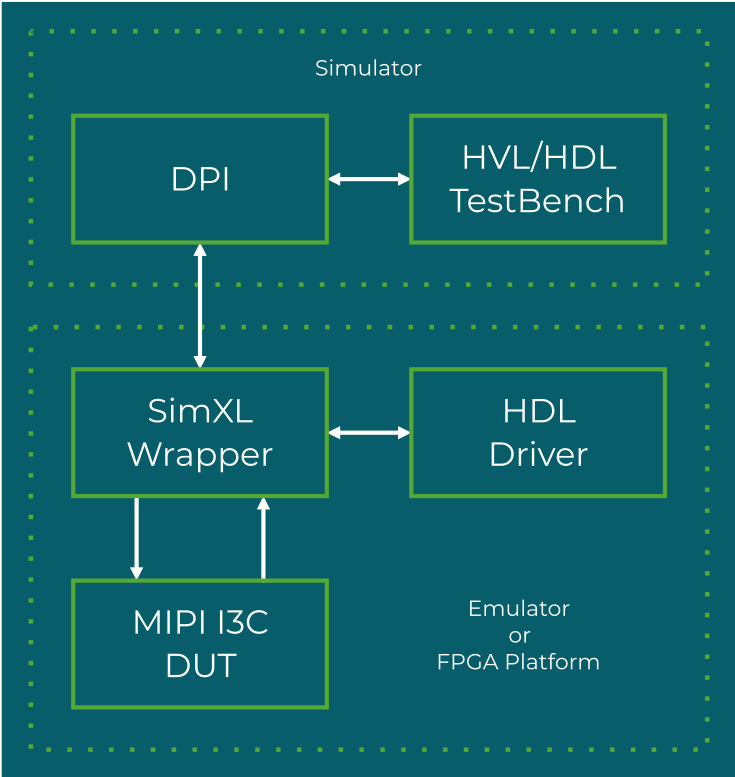
Built for fast compile times and efficient resource utilization on hardware emulation and FPGA prototyping platforms, the transactor is fully synthesizable and platform-independent, deploying without modification across any major emulation or prototyping environment. Its comprehensive Controller and Target error injection suite covering S0-S5 and M0-M1 error categories and HDR error types, combined with rich configuration parameters controlling I3C functionality, enable rapid deployment for early software bring-up and system-level validation regardless of the underlying emulation platform.
Request Data Sheet
MIPI I3C Transactor
Key Features
  • Full MIPI I3C Controller and Target Model – Complete Controller and Target behavior per MIPI I3C v1.2 supporting all I3C device types and all standard bus topologies including Single/Multi Controller and Single/Multi Target configurations
  • Comprehensive Protocol CoverageSDR messaging (standard, Direct CCC, and Broadcast CCC addressing), HDR-DDR messaging, all Common Command Codes, In-Band Interrupt, and Hot-Join support
  • Flexible Addressing – Dynamic Address Assignment, Static Addressing for legacy I2C devices, I3C address arbitration, and 7-bit configurable Target address
  • Legacy I2C Compatibility – Seamless I2C device co-existence on the same bus for flexible mixed-protocol system validation
  • Mixed Message Type Support – Mixing of various message types for comprehensive I3C bus traffic scenario modeling
  • Controller Error InjectionController read data abort mid-transfer, S0 to S5 error injection and recovery, HDR command code preamble and parity errors, HDR write data preamble and parity errors, and HDR write CRC preamble and CRC errors
  • Target Error Injection – M0 to M1 error injection and recovery, HDR read data preamble and parity errors, and HDR read CRC errors
  • On-the-Fly Protocol CheckingReal-time protocol and data checking during emulation runs with testbench notification of significant events, warnings, timing, and protocol violations
Compliance and Compatibility
  • Fully compliant with MIPI I3C v1.2 specification; backward compatible with I3C v1.1.1 and v1.1
  • Uses current MIPI Alliance terminology: Controller (formerly Master) and Target (formerly Slave)
  • Compatible with legacy I2C devices on the same bus
  • Fully synthesizable and platform-independent, deployable on any hardware emulation or FPGA prototyping platform
  • Vendor-agnostic integration suitable for Synopsys, Cadence, Siemens, and custom emulation and prototyping environments
  • Configurable interface supporting integration into custom emulation and prototyping testbenches

Request Datasheet