Contact Us
Overview

SmartDV’s MIPI I3C Slave IP is a silicon-proven, fully featured I3C peripheral solution purpose-built for SoC designs requiring efficient, low-pin-count connectivity to an I3C master controller across mobile, IoT, automotive, and embedded applications. Fully compliant with MIPI I3C v1.2, it delivers complete slave-side I3C functionality with support for all standard and high data rate messaging modes, flexible multi-master and multi-slave bus topologies, and seamless legacy I2C device co-existence on the same bus.

Designed for the diverse connectivity requirements of modern peripheral SoC designs, the IP supports the full HDR messaging suite including HDR-DDR, HDR-TSL, and HDR-TSP modes alongside In-Band Interrupt and Hot-Join capabilities, giving peripheral teams a production-tested, spec-complete I3C slave implementation that maximizes bus efficiency while minimizing pin count and power consumption. Its support for both Dynamic and Static addressing and I3C address arbitration makes it equally well-suited for new I3C native designs and mixed I2C/I3C legacy integration scenarios.

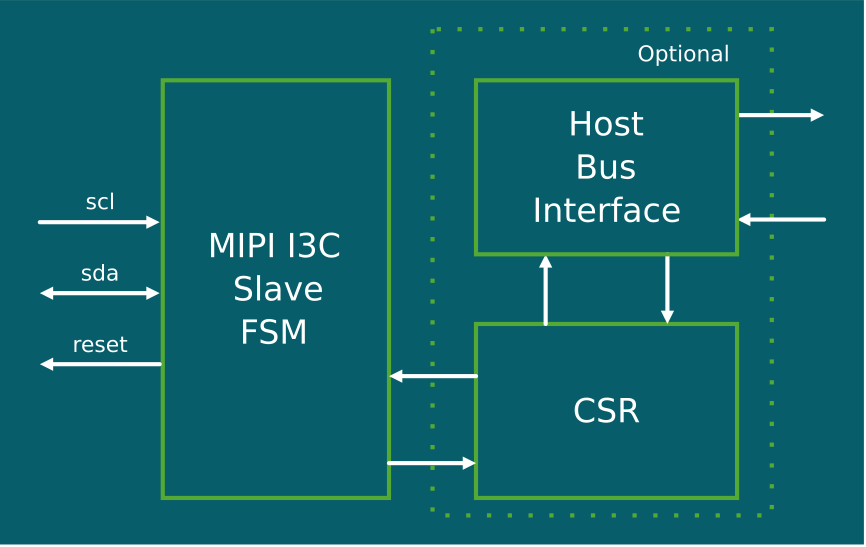
Built for design flexibility and silicon efficiency, the IP core is highly configurable for both ASIC and FPGA implementations, with a strong focus on area optimization, power management, and peak performance. Its parameterized architecture and clean host interface enable fast integration and confident design bring-up across a wide range of process nodes and target applications.
Request Data Sheet
MIPI I3C Slave
Benefits
  • Full MIPI I3C Slave Functionality – Complete slave-side implementation per MIPI I3C v1.2 with two-wire serial interface up to 12.5 MHz using Push-Pull
  • Comprehensive HDR Mode Support – HDR-Dual Data Rate (HDR-DDR), HDR-Ternary Symbol Legacy Mode (HDR-TSL), and HDR-Ternary Symbol Pure-Bus Mode (HDR-TSP) for maximum throughput flexibility
  • Flexible Bus Topology Support – Single Master-Single Slave, Single Master-Multi Slave, Multi Master-Single Slave, and Multi Master-Multi Slave configurations for versatile SoC integration
  • SDR Messaging Support – Single Data Rate messaging with both Directed and Broadcast CCC addressing for standards-compliant command and control communication
  • Dynamic and Static Addressing – Dynamic Address Assignment with Static Addressing support for legacy I2C devices and full I3C address arbitration
  • Advanced Interrupt and Join Support – In-Band Interrupt and Hot-Join support for efficient, low-latency event-driven communication with the I3C master
  • Legacy I2C Compatibility – Seamless co-existence with legacy I2C devices on the same bus for flexible mixed-protocol system integration
Compliance and Compatibility
  • Fully compliant with MIPI I3C v1.2 specification
  • Configurable SoC interface supporting AMBA AXI, AHB, APB, and custom wrappers for seamless integration
  • Compatible with ASIC and FPGA design flows across leading foundry process nodes
  • Compatible with all major EDA synthesis, simulation, and linting flows

Request Datasheet