Contact Us
Overview

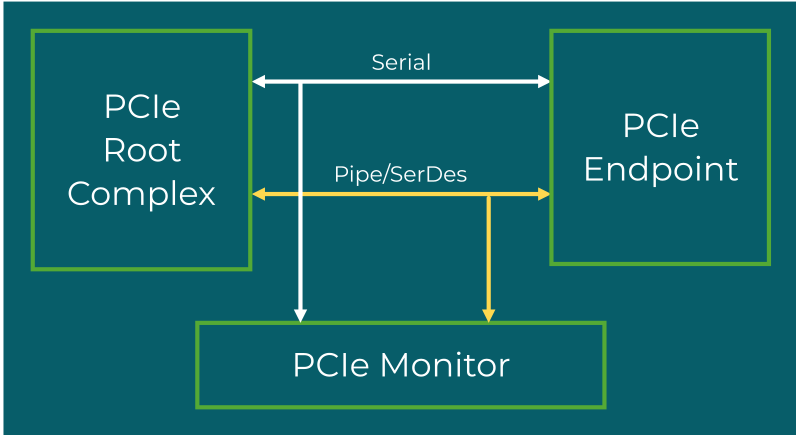
SmartDV’s PCIe Verification IP is a comprehensive solution for verifying the PCI Express high-speed serial interconnect across all defined generations for AI accelerators, data center infrastructure, storage, networking, automotive, and embedded computing applications. Fully compliant with PCI Express 7.0 (June 2025) and backward compatible through PCIe 6.0, 5.0, 4.0, 3.0, 2.1, 2.0, and 1.0, it supports complete verification of PCIe Root Complex and Endpoint components across configurable link widths from x1 to x32, PIPE, PCS/PMA, Message Bus, and SerDes interfaces, all defined encoding schemes from 8b/10b through 128b/130b to 1b/1b, Flit and non-Flit modes, PAM4 signaling, Forward Error Correction, all power management states including L0p, 8 virtual channels, SR-IOV, IDE, DOE, and the full PCIe protocol stack across transaction, data link, and physical layers.

SmartDV’s PCIe VIP supports UVM, SystemVerilog, and Verilog, and integrates seamlessly into diverse verification environments. It is simulator-independent and compatible with all leading EDA simulators, providing flexibility across simulation platforms.

With full LTSSM and DLL state machines, automated error injection at all layers, Lane Margining at Receiver, Shared Credit Pool, Link Management DLLP, Gray coding and Precoding, Spread Spectrum Clocking, up-configure, polarity inversion, lane skew, built-in functional coverage, and a complete test suite, SmartDV’s PCIe VIP enables verification teams to thoroughly validate PCIe interface designs for AI accelerators, data center switches, NVMe SSDs, GPUs, network adapters, automotive SoCs, and high-performance computing platforms.
Request Data Sheet
PCIe VIP
Benefits
  • Full Root Complex and Endpoint Support Across All Generations – Provides complete PCIe Root Complex and Endpoint component verification across PCIe Gen 1 through Gen 7 with PIPE, PCS/PMA, Message Bus, and SerDes interfaces, configurable link widths of x1, x2, x4, x8, x12, x16, and x32, full link speed and width negotiation up to 32 lanes, up-configure, polarity inversion, and lane-to-lane skew, SERDES model with clock recovery, and configurable Spread Spectrum Clocking.
  • Encoding and Physical Layer Coverage – Supports Gen 1 and Gen 2 8b/10b encoding, Gen 3, Gen 4, and Gen 5 128b/130b encoding, and Gen 6 and Gen 7 1b/1b encoding with PAM4 signaling, Gray coding and Tx Precoding, Flit mode and non-Flit mode, Forward Error Correction mechanism, and Error Correction Code mechanism as defined in PCIe 6.0 and 7.0.
  • Transaction Layer Coverage – Supports multiple Requester and Completer applications including user-supplied applications, 8 virtual channels with configurable queue depth, configurable TC to VC queue mapping, user interface for direct TLP queuing and receipt, checks for all TLP headers, prefixes, and ECRC formation, Scaled Flow Control, Shared Credit Pool, Lane Margining at Receiver, VF 10-Bit Tag Requester, Enhanced Allocation, Alternate Protocol Negotiation, and Conventional PCI Advanced Features.
  • Data Link Layer Coverage – Provides full Data Link Layer state machine verification, checking all framing, LCRC, and lane rules, all DLLP fields and formatting, interface to send and receive user-defined DLLPs, and Link Management DLLP support.
  • Advanced Security and Protocol Features – Supports IDE (Integrity and Data Encryption) for secure PCIe link communication, DOE (Data Object Exchange) for in-band protocol negotiation, SR-IOV (Single Root I/O Virtualization) for hardware-based I/O virtualization, and L0p state for active power management.
  • Power Management Support – Supports ASPM Active State Power Management and software-controlled power management, L0p state for fine-grained power scaling, and all defined PCIe power state transitions across all supported generations.
  • Comprehensive Error Injection and Detection – Provides automated error injection at all protocol layers including transaction, data link, and physical layers, with checkers verifying protocol timing checks and functional accuracy at each layer across all PCIe generations and link configurations.
  • Complete Verification Infrastructure – Provides a full test suite covering all PCIe 7.0 specification features, built-in functional coverage analysis, configurable timers and timeouts, and callbacks in Root Complex, Endpoint, and Monitor for user-defined event handling and protocol and timing violation notification.
Compliance and Compatibility
  • Fully compliant with PCIe 7.0 (June 2025); backward compatible with PCIe 6.0, 5.0, 4.0, 3.0, 2.1, 2.0, and 1.0
  • Supports configurable link widths from x1 to x32 across all generations
  • Supports 8b/10b (Gen 1/2), 128b/130b (Gen 3/4/5), and 1b/1b PAM4 (Gen 6/7) encoding
  • Supports Flit and non-Flit modes, FEC, IDE, DOE, SR-IOV, and L0p state
  • Compliant with PIPE specification for PHY interface
  • Compatible with UVM, OVM, VMM, SystemVerilog, and Verilog verification environments
  • Compatible with all major EDA simulators including Synopsys VCS, Cadence Xcelium, Siemens Questa, Aldec Riviera-PRO, and Verilator

Request Datasheet