SmartDV‘s PCIe Synthesizable Transactor is a fully featured PCI Express bus model purpose-built for hardware emulation and FPGA prototyping environments requiring fast, accurate, and highly configurable PCIe Root Complex and Endpoint behavior during pre-silicon validation of embedded, automotive, AI/ML, HPC, and data center SoC designs. Fully compliant with PCI-SIG PCIe 6.0 and backward compatible with PCIe 5.0, 4.0, 3.1, 2.1, and 1.0, it delivers complete Root Complex and Endpoint functionality across all PCIe generations from Gen1 at 2.5 GT/s through Gen6 at 64 GT/s with PAM4 signaling, giving validation teams a single drop-in synthesizable PCIe transactor spanning the full range of PCIe protocol generations used in modern SoC designs.
Designed for the speed and visibility demands of emulation and FPGA prototyping rather than ASIC tape-out, the transactor emphasizes fast bring-up, fine-grained controllability, and on-the-fly protocol checking over area or power optimization. It supports complete LTSSM state machine modeling, speed and link width negotiation, lane polarity inversion and reversal detection and correction, FLIT and Non-FLIT mode operation, all TLP types with header, prefix, and ECRC validation, DLLP field checking, scaled flow control, data link feature exchange, up to 8 Virtual Channels and 8 Traffic Classes, and the full PCIe power management suite, enabling validation teams to exercise corner-case PCIe behavior that is difficult to reach with production RTL alone.
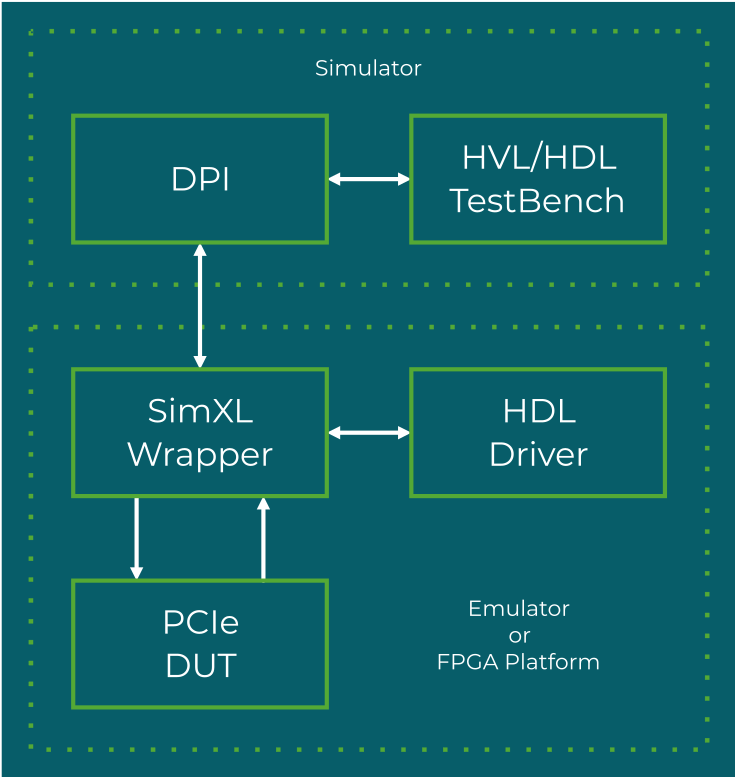
Built for fast compile times and efficient resource utilization on hardware emulation and FPGA prototyping platforms, the transactor is fully synthesizable and platform-independent, deploying without modification across any major emulation or prototyping environment. Its comprehensive error injection suite, programmable timeout insertion, lane margining support, and testbench notification of significant events, warnings, timing, and protocol violations enable rapid deployment for early software bring-up and PCIe system-level validation regardless of the underlying emulation platform.