Contact Us
Overview

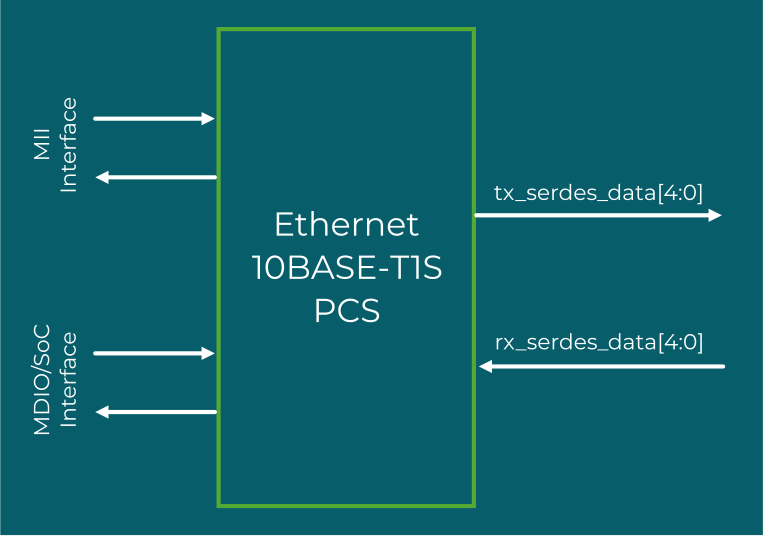
SmartDV’s Ethernet 10BASE-T1S PCS IP is a silicon-proven, fully featured Physical Coding Sublayer solution purpose-built for SoC designs requiring cost-effective, multidrop single-pair Ethernet connectivity across automotive zonal architecture, industrial automation, and building automation applications. Fully compliant with IEEE 802.3cg-2019 Clause 147, it delivers complete 10BASE-T1S PCS functionality supporting both point-to-point and half-duplex multidrop topologies at 10 Mbps over a single balanced twisted pair, enabling up to 8 nodes on a shared bus without requiring a dedicated Ethernet switch.

Designed for the demanding determinism and reliability requirements of automotive and industrial multidrop networks, the IP supports full-duplex and half-duplex point-to-point operation, half-duplex shared-medium multidrop using CSMA/CD, optional PHY-Level Collision Avoidance (PLCA) reconciliation sublayer per Clause 148 for deterministic, collision-free transmit opportunity allocation, and Differential Manchester Encoding (DME) with 4B5B encoding for robust signal integrity and clock recovery. Its bus-goldilocks positioning between legacy CAN networks and higher-speed 100/1000BASE-T1 links gives automotive and industrial SoC teams a production-ready 10BASE-T1S PCS implementation for cost-effective sensor and zonal network connectivity.

Built for design flexibility and silicon efficiency, the IP core is highly configurable for both ASIC and FPGA implementations, with a strong focus on area optimization, power management, and peak performance. Its parameterized PCS architecture and clean host interface enable fast integration across a wide range of automotive and industrial process nodes.
Request Data Sheet
Ethernet 10BASE-T1S PCS
Key Features
  • Full 10BASE-T1S PCS Functionality – Complete PCS implementation per IEEE 802.3cg-2019 Clause 147 supporting point-to-point and half-duplex multidrop topologies at 10 Mbps
  • Multidrop Bus Support – Half-duplex shared-medium multidrop operation supporting at least 8 nodes over channels up to 25 meters using CSMA/CD
  • PHY-Level Collision Avoidance – Optional PLCA reconciliation sublayer per Clause 148 for deterministic, collision-free transmit opportunity scheduling with round-robin PHY ID allocation
  • Differential Manchester Encoding – DME with 4B5B encoding for robust signal integrity, guaranteed clock transitions, and reduced EMI susceptibility
  • Flexible Duplex Modes – Full-duplex and half-duplex point-to-point operation with 15-meter reach, extended to 25 meters in multidrop configurations
  • Energy Efficient Ethernet Support – Optional EEE capability with Low Power Idle entry for power-efficient sensor and edge node operation
  • Standard Frame Format Retention – Full retention of classic Ethernet frame format for seamless higher-layer protocol compatibility
  • Beacon-Based Synchronization – BEACON signal generation and detection for PLCA cycle initiation and transmit opportunity ordering
  • Automotive and Industrial EMC Compliance – Architecture optimized to meet stringent automotive and industrial electromagnetic compatibility requirements
  • Loopback and Diagnostic Support – Configurable loopback modes and diagnostic features for design validation and field-level fault isolation
  • MII-Compatible Interface – Compatible with standard MII interface per IEEE 802.3 Clause 22 for host controller integration
Compliance and Compatibility
  • Fully compliant with IEEE 802.3cg-2019 Clause 147 for 10BASE-T1S
  • Compatible with PLCA reconciliation sublayer per IEEE 802.3cg-2019 Clause 148
  • Configurable SoC interface supporting AMBA AXI, AHB, APB, and custom wrappers for seamless integration
  • Compatible with ASIC and FPGA design flows across leading foundry process nodes
  • Compatible with all major EDA synthesis, simulation, and linting flows

Request Datasheet