Contact Us
Overview

SmartDV’s MIPI TWP Decoder IP is a silicon-proven, fully featured Trace Wrapper Protocol decoder purpose-built for debug infrastructure requiring accurate, standards-compliant recovery of individual trace streams from a merged TWP-formatted input. Fully compliant with MIPI TWP v1.1, it implements the complete TWP de-wrapping architecture, parsing a single 128-bit framed input and reconstructing up to 111 independent source trace streams, including STP, processor trace, and custom trace sources, for delivery to downstream storage, export, or debug tool consumption.

Designed as the central trace de-aggregation block within the Debug and Trace Controller (DTC) side of a complete MIPI debug and trace infrastructure, the IP parses all three TWP layers: T3 mandatory 16-byte Data frames, T2 Alignment Synchronization Frame Sync Packets, and T1 Flow Control Padding Packets, correctly identifying special source IDs for NULL padding (0x00), trigger (0x7D), marker (0x7C), and flush marker (0x7B, added in v1.1) as it reconstructs each source stream. Its ability to recover decode alignment from any position in the stream via Frame Synchronization Packets, even after data loss or a lost stream start, makes it a robust, ecosystem-compatible complement to PTI, HTI, and GbT network adaptors, and a natural pairing with ARM CoreSight-based debug tooling.

Built for design flexibility and silicon efficiency, the IP core is highly configurable for both ASIC and FPGA implementations, with a strong focus on area optimization, power management, and peak performance. Its parameterized architecture and clean on-chip interface enable fast integration and confident design bring-up across a wide range of process nodes and debug infrastructure applications.
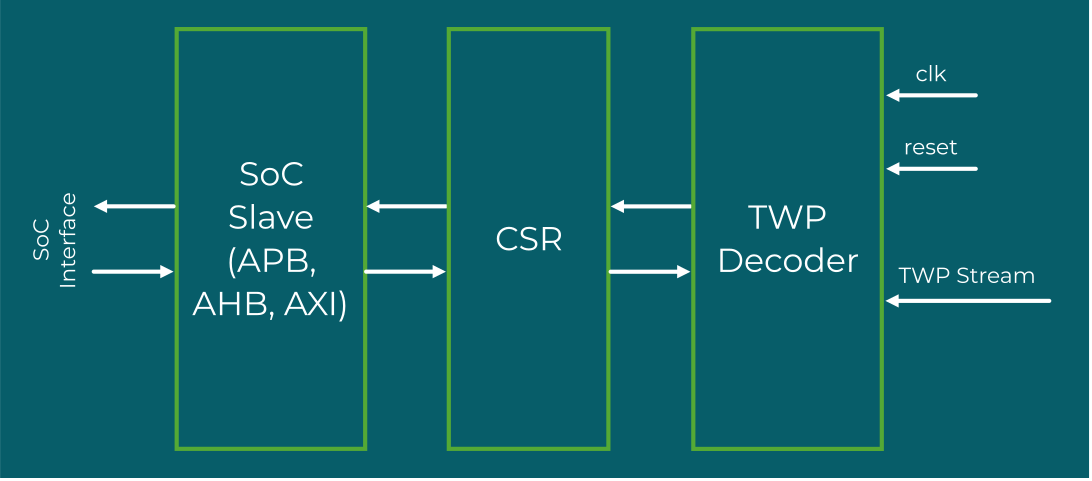
MIPI TWP Decoder
Key Features
  • Full MIPI TWP De-Wrapping and Decoding Functionality – Complete TWP decoder per MIPI TWP v1.1, recovering up to 111 independent source trace streams each identified by a 7-bit ID from a single 128-bit framed input
  • Three-Layer TWP Frame Parsing – T3 mandatory 16-byte Data frames, T2 Alignment Synchronization Frame Sync Packets, and T1 Flow Control Padding Packets for standards-compliant trace stream reconstruction
  • Special Source ID Recognition – Identifies and handles NULL/padding (0x00), trigger (0x7D), marker (0x7C), and flush marker (0x7B, added in v1.1) source IDs during decode for accurate stream recovery
  • Decode Recovery from Any Stream Position – Detects Frame Synchronization Packets with 31 or more ones followed by a zero to realign and resume decode after stream interruption, data loss, or a missed stream start
  • Trigger Event Extraction – Extracts trigger event indications for the Debug and Trace Controller, supporting precise trace capture control in complex debug scenarios
  • Efficient Stream Reconstruction – Low-latency de-wrapping with minimal buffering overhead for real-time downstream consumption
  • ARM CoreSight Compatible – Fully compatible superset of the ARM CoreSight Trace Formatter decode path for broad debug tool ecosystem interoperability
  • Gigabit Trace Support – GbT Network Adaptor compatibility for trace ingestion over functional networks including USB
Compliance and Compatibility
  • Fully compliant with MIPI TWP v1.1 specification
  • Compatible with MIPI STP v2.4 for trace source stream wrapping
  • Compatible with MIPI HTI v1.1 and MIPI PTI v2.0.1 for trace export
  • Compatible with ARM CoreSight Trace Formatter implementations
  • Configurable SoC interface supporting AMBA AXI, AHB, APB, and custom wrappers for seamless integration
  • Compatible with ASIC and FPGA design flows across leading foundry process nodes
  • Compatible with all major EDA synthesis, simulation, and linting flows