Contact Us
Overview

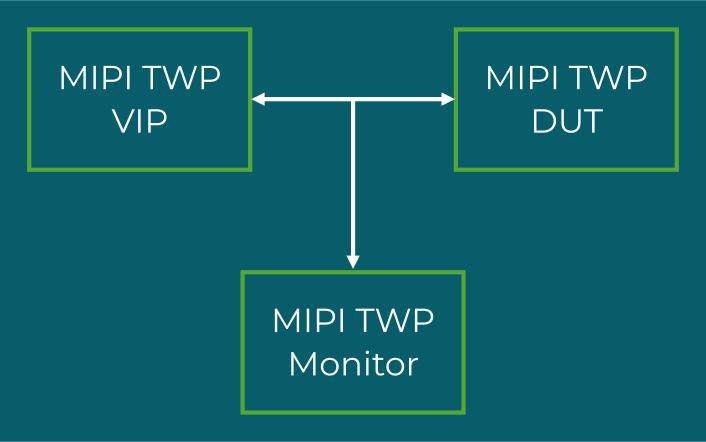
SmartDV’s MIPI TWP Verification IP is a comprehensive solution for verifying the MIPI Trace Wrapper Protocol, a byte-stream merging protocol that combines multiple independent source trace streams into a single unified trace stream for export via high-speed trace interfaces such as MIPI HTI and MIPI PTI. Based on ARM CoreSight Trace Formatter Protocol and fully compliant with MIPI TWP v1.1, it supports complete verification of TWP Debug and Test System and Debug and Trace Controller components across the TWP interface between DTS and DTC, up to 111 source trace streams, all three defined layer types, synchronization point generation, trigger event positioning, output padding, and transport-agnostic bit stream export across any transport supporting bit stream data.

SmartDV’s MIPI TWP VIP supports UVM, SystemVerilog, and Verilog, and integrates seamlessly into diverse verification environments. It is simulator-independent and compatible with all leading EDA simulators, providing flexibility across simulation platforms.

With low additional bandwidth overhead, efficient memory storage for later retrieval, decode recovery from any stream position via synchronization points, complete layer coverage for Flow Control, Alignment Synchronization, and Data, built-in functional coverage, and a complete test suite, SmartDV’s MIPI TWP VIP enables verification teams to thoroughly validate trace wrapper protocol interface designs for mobile SoCs, automotive ECUs, IoT devices, and any embedded system requiring multi-source trace stream merging and standardized export.
Request Data Sheet
MIPI TWP VIP
Key Features
  • Full DTS and DTC Support – Provides complete MIPI TWP Debug and Test System and Debug and Trace Controller component verification across the TWP interface between DTS and DTC, supporting up to 111 independent source trace streams merged into a single unified trace stream with unique ID assignment per stream and efficient byte-stream transport.
  • Comprehensive Layer Type CoverageSupports all three defined TWP layer types including Flow Control layer for managing trace data flow between source and sink, Alignment Synchronization layer for ensuring byte and word boundary detection even when transmitted as a bit stream, and Data layer for carrying merged trace payload content.
  • Stream Merging and Transport Features – Supports merging of up to 111 independent source trace streams regardless of data format, transport-agnostic bit stream output compatible with any transport supporting bit stream data, efficient storage to memory with power-of-two width for later retrieval, low additional bandwidth overhead, and output padding for scenarios where the transport interface cannot be idled when valid data is unavailable.
  • Synchronization and Trigger Support – Supports synchronization point generation enabling decode recovery even when the start of the trace is lost, trigger event position indication to the Debug and Trace Controller for controlling trace data capture actions, and cross-stream synchronization for multi-source trace analysis.
  • Complete Verification Infrastructure – Provides a full test suite covering all MIPI TWP v1.1 specification features, built-in functional coverage analysis, constraints randomization, status counters for bus events, and callbacks in transmitter, receiver, and monitor for user-defined data processing and protocol and timing violation notification.
Compliance and Compatibility
  • Fully compliant with MIPI TWP v1.1 (December 2014)
  • Based on ARM CoreSight Trace Formatter Protocol
  • Supports up to 111 independent source trace streams
  • Supports all transports carrying bit stream data including MIPI HTI and MIPI PTI
  • Publicly available specification — no MIPI membership required
  • Compatible with UVM, OVM, VMM, SystemVerilog, and Verilog verification environments
  • Compatible with all major EDA simulators including Synopsys VCS, Cadence Xcelium, Siemens Questa, Aldec Riviera-PRO, and Verilator

Request Datasheet