Contact Us
Overview

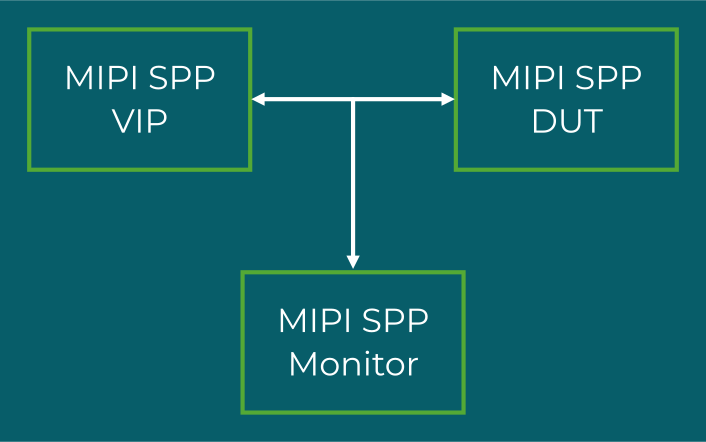
SmartDV’s MIPI SPP Verification IP is a comprehensive solution for verifying the MIPI SneakPeek Protocol, the standardized debug communications protocol connecting Debug and Test Systems with Target Systems through address-mapped read and write transactions that abstract the underlying debug transport interface. Fully compliant with MIPI SPP v2.2 (April 2026) and backward compatible with v2.1, v2.0, and v1.0, it supports complete verification of SPP Debug and Test System and Target System components across independent full-duplex communication, Full SPP and Tiny SPP packet types, all defined opcodes, dynamic SPTB sizing, up to 32 access spaces with 32-bit configuration register addressing, 64-bit system address width, JTAG Access Space, Secure Communication Manager Access Space, and comprehensive error injection and detection across all defined SPP error types.

SmartDV’s MIPI SPP VIP supports UVM, SystemVerilog, and Verilog, and integrates seamlessly into diverse verification environments. It is simulator-independent and compatible with all leading EDA simulators, providing flexibility across simulation platforms.

With normal and error response generation, complete configuration register and access space verification, JTAG packetized messaging, secure debug communication support, built-in functional coverage, and a complete test suite, SmartDV’s MIPI SPP VIP enables verification teams to thoroughly validate SneakPeek Protocol debug interface designs for mobile SoCs, IoT devices, automotive ECUs, and any embedded system requiring standardized transport-agnostic debug connectivity.
Request Data Sheet
MIPI SPP VIP
Key Features
  • Full DTS and TS Support – Provides complete MIPI SPP Debug and Test System and Target System component verification across independent full-duplex communication, supporting normal and error response generation, read data comparison against expected results, and all defined configuration registers and access space related configuration registers with 32-bit register addressing.
  • Full SPP and Tiny SPP Packet Coverage – Supports Full SPP packets for standard debug operations and Tiny SPP packets optimized for high-latency, low-bandwidth interfaces such as IoT and low-power devices, with dynamic SPTB sizing including single packet per SPTB, variable-sized SPTB, and constant-sized SPTB configurations.
  • Comprehensive Opcode CoverageSupports all defined SPP opcodes including Write System, Read System, Write SP Config, Read SP Config, Unblock SP Engine, Initialize SP Engine, NOP, Pad, Write Read System, and Loop Trig System, covering complete command and response plane verification across all access space types.
  • Access Space and JTAG SupportSupports up to 32 access spaces, write and read system transactions with 64-bit address width, JTAG Access Space for packetized JTAG messaging that reduces overhead of JTAG state changes, and Secure Communication Manager Access Space for DMTF SPDM-based secure debug communication as introduced in SPP v2.1.
  • Comprehensive Error Injection and Detection – Supports injection and detection of all defined SPP error types including bad version, bad command and response sequence number, bad opcode in CE check first state, bad position of special opcode, bad end of SPTB, bad opcode, bad signature, bad config TBC, bad config size, bad config address, bad config register, bad config write, bad config read, bad access space unavailable, bad access space non-existent, bad access space disabled, bad access space busy, bad system size, bad system address, bad system TBC, system timeout busy, system timeout not busy, bad response type, invalid response type, invalid error type, and invalid error code errors.
  • Complete Verification Infrastructure – Provides built-in functional coverage analysis, status counters for bus events, and callbacks in DTS, TS, and Monitor for user-defined event handling and protocol and timing violation notification across all SPP operating conditions.
Compliance and Compatibility
  • Fully compliant with MIPI SPP v2.2 (April 2026); backward compatible with v2.1, v2.0, and v1.0
  • Supports Full SPP and Tiny SPP packet types
  • Supports JTAG Access Space and Secure Communication Manager Access Space
  • Supports up to 32 access spaces with 64-bit system address width
  • Compatible with UVM, OVM, VMM, SystemVerilog, and Verilog verification environments
  • Compatible with all major EDA simulators including Synopsys VCS, Cadence Xcelium, Siemens Questa, Aldec Riviera-PRO, and Verilator

Request Datasheet