Contact Us
Overview

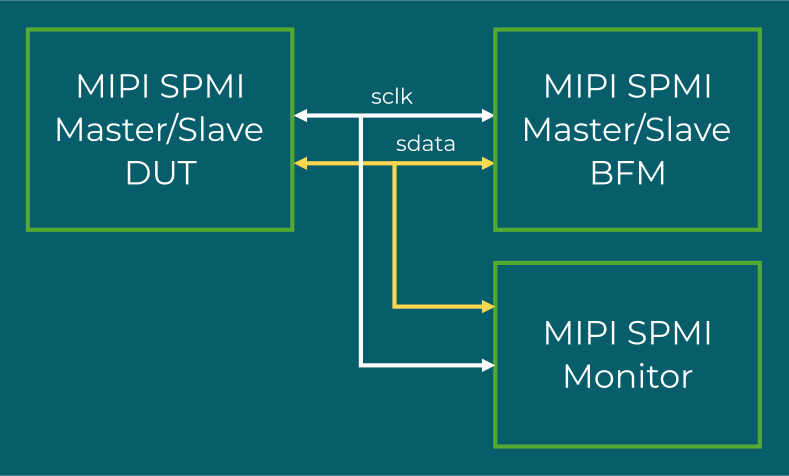
SmartDV’s MIPI SPMI Verification IP is a comprehensive solution for verifying the MIPI System Power Management Interface, the two-wire serial bus standard connecting the integrated power controller of an SoC processor with one or more power management IC voltage regulation systems in mobile and portable devices. Fully compliant with MIPI SPMI v2.0 and backward compatible with v1.0, it supports complete verification of SPMI master and slave components across all defined topologies with up to 4 masters and up to 16 slaves per bus, all SPMI command types, all power mode commands, all frame types, all master bus connection mechanisms, group slave ID, device enumeration, and ACK/NACK generation as defined in SPMI v2.0.

SmartDV’s MIPI SPMI VIP supports UVM, SystemVerilog, and Verilog, and integrates seamlessly into diverse verification environments. It is simulator-independent and compatible with all leading EDA simulators, providing flexibility across simulation platforms.

With comprehensive glitch injection and detection on both SDATA and SCLK, slave request handling via Alert bit and Slave Request Bit, master and slave arbitration, half-speed and full-speed mode support, bus-accurate timing, built-in functional coverage, and a complete test suite, SmartDV’s MIPI SPMI VIP enables verification teams to thoroughly validate SPMI power management interface designs for smartphones, tablets, wearables, and IoT devices requiring dynamic voltage scaling and real-time power control.
Request Data Sheet
MIPI SPMI VIP
Key Features
  • Full SPMI Master and Slave Support – Provides complete MIPI SPMI master and slave component verification across all defined topologies with up to 4 masters and up to 16 slaves per bus, supporting multi-master and multi-slave configurations, master and slave arbitration, device enumeration, Group Slave ID configuration, and configurable operation as master, slave, or both.
  • Master Bus Connection and Frame Coverage – Supports all three master bus connection mechanisms including connection by detecting SSC, connection by detecting Bus Idle, and connection by detecting Bus Arbitration, and all defined frame types including Command Frame, Address/Data Frame, and No Response Frame, covering all SPMI command sequences and power mode commands.
  • SPMI v2.0 Feature Support – Supports ACK/NACK generation as defined in SPMI v2.0, slave requests through Alert bit and Slave Request Bit, Slave Request Hold, read data comparison against expected results, half-speed and full-speed mode operation, and backward compatibility with SPMI v1.0 Non-Request Capable Slave devices.
  • Comprehensive Error Injection and Detection – Supports all defined SPMI error types including undefined command frame, command frame with parity error, command frame length error, address frame with parity error, data frame with parity error, read and write of unused registers, read using broadcast ID or GSID, and ACK/NACK errors.
  • Glitch Injection and Detection – Supports injection of glitches at all positions of SDATA and SCLK signals, and detection of glitches across all bus signal conditions for comprehensive physical layer fault simulation.
  • Complete Verification Infrastructure – Provides built-in functional coverage analysis, bus-accurate timing, status counters for bus events, and callbacks in master, slave, and monitor for user-defined event handling and protocol and timing violation notification.
Compliance and Compatibility
  • Fully compliant with MIPI SPMI v2.0 (August 2012); backward compatible with SPMI v1.0
  • Supports High-Speed (32 KHz to 26 MHz) and Low-Speed (32 KHz to 15 MHz) device classes
  • Supports up to 4 masters and up to 16 slaves per bus instance
  • Compatible with UVM, OVM, VMM, SystemVerilog, and Verilog verification environments
  • Compatible with all major EDA simulators including Synopsys VCS, Cadence Xcelium, Siemens Questa, Aldec Riviera-PRO, and Verilator

Request Datasheet