Contact Us
Overview

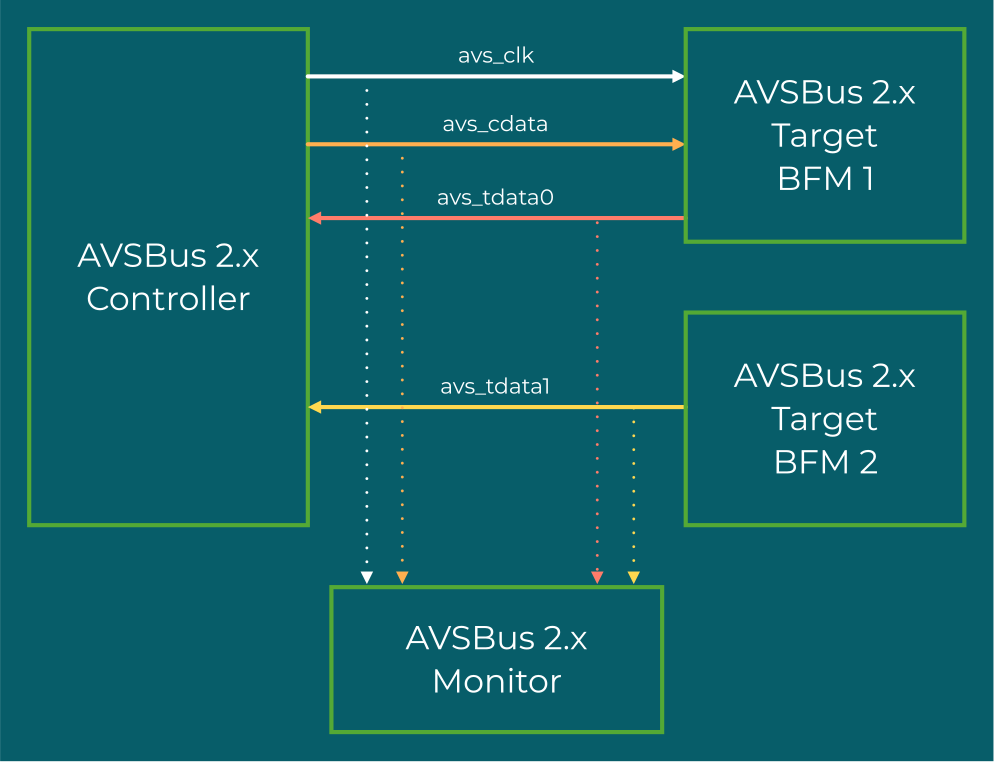
SmartDV’s AVSBus 2.0 Verification IP is a comprehensive solution for verifying the standalone Adaptive Voltage Scaling Bus 2.0 protocol, a significant evolution of the AVSBus standard introducing multi-target support, extended frame formats, and enhanced power management capabilities for next-generation ASIC, FPGA, and processor power control designs. Fully compliant with the AVSBus version 2.0 specification, it supports complete verification of AVSBus 2.0 Controller and Target components across 3-wire interface configurations, covering all AVSBus 2.0 commands, single controller and multiple target topologies supporting up to 15 targets via 4-bit target addressing, broadcast addressing, and multiple link configurations with 48-bit long frames and data widths up to 96 bits.

SmartDV’s AVSBus 2.0 VIP supports UVM, SystemVerilog, and Verilog, and integrates seamlessly into diverse verification environments. It is simulator-independent and compatible with all leading EDA simulators, providing flexibility across simulation platforms.

With Abort frame functionality, clock pausing between command frames, Target status response frames, back-to-back command support, user response frames, comprehensive error injection across all AVSBus 2.0 error types, built-in functional coverage, and a complete test suite, SmartDV’s AVSBus 2.0 VIP enables verification teams to thoroughly validate next-generation multi-target adaptive voltage scaling designs for advanced ASIC, FPGA, processor, and SoC power management applications.
Request Data Sheet
AVSBus 2.x VIP
Key Features
  • Full Controller and Target Support – Provides complete AVSBus 2.0 Controller and Target functionality with 4-bit target addressing supporting up to 15 targets, broadcast address support, 3-wire interface operation, 48-bit long frames with data widths up to 96 bits, and all AVSBus 2.0 commands as per specification.
  • Multi-Target Topology Support – Supports single Controller and multiple Target topologies with up to 15 addressable targets, multiple link configurations, and frame alignment, enabling verification of complex multi-rail power management architectures not supported in earlier AVSBus versions.
  • Frame and Clock Management – Supports Abort frame functionality for transaction cancellation, clock pausing between command frames, back-to-back command transmission, Target status response frames, user response frames, timeout detection and generation, and complete frame alignment verification.
  • Comprehensive Error Injection and Detection – Supports injection and detection of all AVSBus 2.0 error types including Start Code errors, CRC errors, Selector errors, Framing errors, Command Type errors, Command Group errors, Command Data Type errors, Unavailable Resource errors, Invalid Reserved Bit errors, and invalid TDATA and CDATA values during clock suspension.
  • Complete Verification Infrastructure – Provides built-in functional coverage analysis, constraints randomization, and callbacks in Controller, Target, and Monitor for user-defined event handling, data and command modification and sampling, and protocol violation notification with separate log file output.
Compliance and Compatibility
  • Fully compliant with AVSBus version 2.0 specification
  • Supports single Controller and multiple Target topologies with up to 15 targets
  • Compatible with UVM, OVM, VMM, SystemVerilog, and Verilog verification environments
  • Compatible with all major EDA simulators including Synopsys VCS, Cadence Xcelium, Siemens Questa, Aldec Riviera-PRO, and Verilator

Request Datasheet