Contact Us
Overview

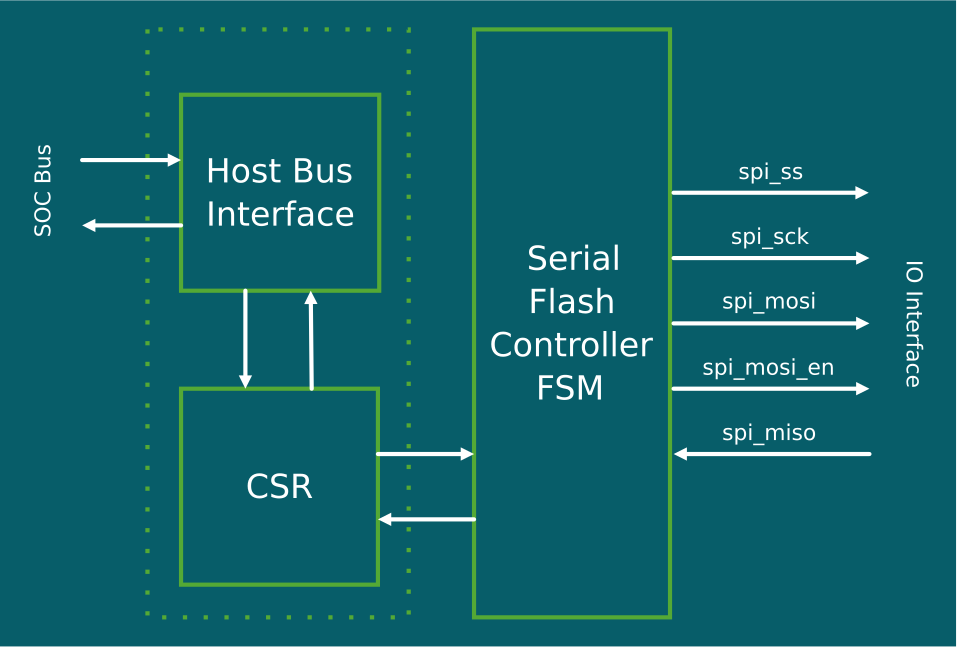
SmartDV’s Serial Flash Controller IP is a silicon-proven, fully featured SPI master controller solution purpose-built for SoC designs requiring flexible, high-performance connectivity to serial flash memory devices and other SPI peripherals across embedded, automotive, IoT, and consumer electronics applications. Compatible with flash devices from all major vendors and compliant with JEDEC xSPI (JESD251) and Xccela standards with optional HyperBus support, it delivers complete serial flash controller functionality supporting Single, Dual, Quad, and Octal SPI data widths in both SDR and DDR modes, with up to 16 slave devices under master control.

Designed to address the full breadth of serial flash and SPI peripheral integration requirements, the IP supports three distinct operating modes: Slave Mode for CSR register-based flash access, XIP (eXecute In-Place) Mode for direct memory-mapped flash execution, and HCI Mode for descriptor-based DMA-type access. Its support for both 3-wire and 4-wire operation, full and half duplex modes, LSB and MSB data ordering, programmable clock polarity and phase, boot image copy after power-on reset, and configurable FIFO architecture with threshold-based interrupt generation gives SoC teams a production-tested, versatile serial flash controller that handles any SPI transaction type across the widest range of flash and peripheral device configurations.

Built for design flexibility and silicon efficiency, the IP core is highly configurable for both ASIC and FPGA implementations, with a strong focus on area optimization, power management, and peak performance. Its parameterized architecture, software and hardware reset support, and clean host interface enable fast integration and confident design bring-up across a wide range of process nodes and target applications.
Request Data Sheet
Serial Flash Controller
Key Features
  • Full SPI Master Functionality – Single, Dual, Quad, and Octal serial data lines with SDR and DDR mode support for flexible serial flash and SPI peripheral connectivity
  • Three Operating Modes – Slave Mode for CSR register-based access, XIP Mode for direct memory-mapped eXecute In-Place operation, and HCI Mode for descriptor-based DMA-type access
  • Flexible Interface Support – 3-wire and 4-wire operation with full duplex and half duplex modes for compatibility with any SPI slave device type
  • Multi-Slave Support – Up to 16 slave devices under master control with programmable clock polarity, phase, and flexible serial clock generation
  • Boot Image Copy – Autonomous boot image copy support after power-on reset for reliable system bring-up from serial flash
  • Data Ordering and Mode Fault – LSB and MSB mode support with mode fault error flag and CPU interrupt capability for robust SPI bus management
  • xSPI and Xccela Support – Compatible with JEDEC xSPI JESD251 and Xccela with optional HyperBus standard for broad flash device ecosystem coverage
  • Configurable FIFO Architecture – Configurable transmit/receive data FIFOs with threshold-based interrupt generation for efficient data transfer management
  • Software and Hardware Reset – Both software and hardware reset support for flexible system initialization
Compliance and Compatibility
  • Compliant with JEDEC xSPI JESD251 v1.0
  • Compatible with Xccela and optional HyperBus serial flash standards
  • Compatible with flash devices from all major vendors including Infineon, Micron, Macronix, Winbond, and GigaDevice
  • Configurable SoC interface supporting AMBA AXI, AHB, APB, and custom wrappers for seamless integration
  • Compatible with ASIC and FPGA design flows across leading foundry process nodes
  • Compatible with all major EDA synthesis, simulation, and linting flows

Request Datasheet