Contact Us
Overview

SmartDV’s SATA Synthesizable Transactor is a fully featured Serial ATA bus model purpose-built for hardware emulation and FPGA prototyping environments requiring fast, accurate, and highly configurable SATA Host and Device behavior during pre-silicon validation of HDD, SSD, and embedded storage SoC designs. Fully compliant with SATA Revision 3.5 and backward compatible with all prior SATA revisions from 2.5 onwards, it delivers complete Host and Device functionality at 1.5, 3.0, and 6.0 Gbps, giving validation teams a drop-in synthesizable SATA transactor ready for rapid integration into emulation and prototyping flows.

Designed for the speed and visibility demands of emulation and FPGA prototyping rather than ASIC tape-out, the transactor emphasizes fast bring-up, fine-grained controllability, and on-the-fly protocol checking over area or power optimization. It supports complete link layer state machine modeling, 8b/10b encoding and decoding, CRC generation and checking, auto insertion of HOLD primitives, Native Command Queuing with maximum queue depth of 32, First Party DMA, Port Multiplier, Port Selector, selectable data scrambling, CONT primitive for EMI reduction, link layer power modes, DMA and PIO commands, shadow register block, and device signature returns, enabling validation teams to exercise corner-case SATA behavior that is difficult to reach with production RTL alone.

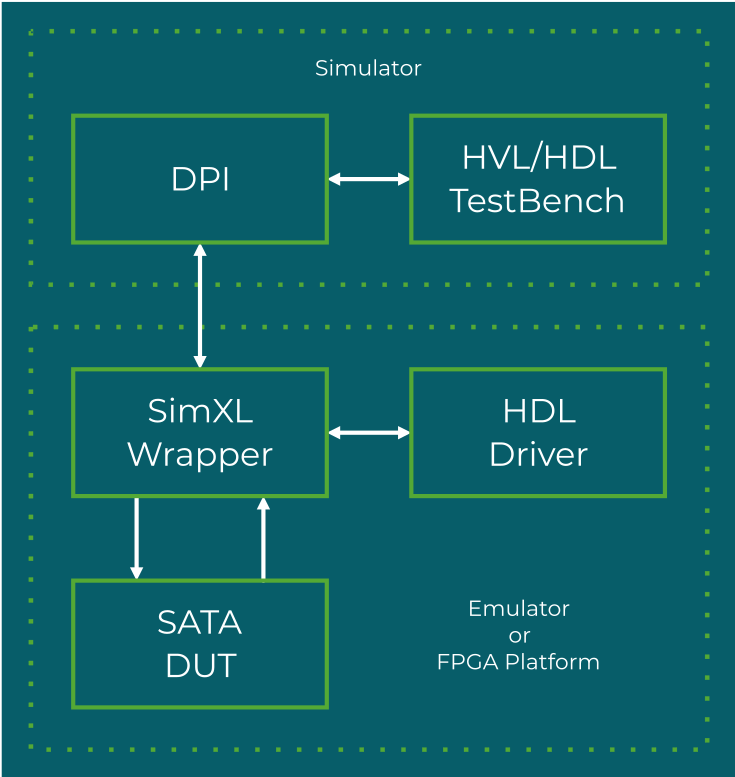
Built for fast compile times and efficient resource utilization on hardware emulation and FPGA prototyping platforms, the transactor is fully synthesizable and platform-independent, deployable on any hardware emulation or FPGA prototyping platform. Its comprehensive error injection capabilities, testbench notification of significant events, warnings, timing, and protocol violations enable rapid deployment for early software bring-up and storage system-level validation regardless of the underlying emulation platform.
Request Data Sheet
SATA Transactor
Key Features
  • Full SATA Host and Device Model – Complete Host and Device behavior per SATA Revision 3.5 supporting 1.5 Gbps, 3.0 Gbps, and 6.0 Gbps data transfer rates
  • Complete Link Layer Model – Full link layer state machine with 8b/10b encoding/decoding, CRC generation and checking, auto insertion of HOLD primitives, and selectable data scrambling
  • Native Command Queuing – Hardware NCQ modeling with maximum queue depth of 32 and First Party DMA for optimized storage performance validation
  • 48-Bit Address Support – Hardware 48-bit address set modeling for storage devices exceeding 128 GB capacity
  • Port Multiplier and Port Selector – Port Multiplier and Port Selector modeling for flexible multi-device storage topology validation
  • EMI Reduction Modeling – CONT primitive support for primitive suppression modeling in EMI-sensitive storage environments
  • Link Layer Power Management – Full link layer power mode modeling for power-efficient storage validation
  • DMA and PIO Command Support – Complete DMA and PIO command modeling with shadow register block and serial ATA status and control registers
  • Device Signature – Device signature returns feature modeling for host-side storage device identification and enumeration validation
  • On-the-Fly Protocol Checking – Real-time protocol and data checking with testbench notification of significant events, warnings, timing, and protocol violations
Compliance and Compatibility
  • Fully compliant with SATA Revision 3.5; backward compatible with SATA Revision 3.4, 3.3, 3.2, 3.1, 3.0, 2.6, and 2.5
  • Supports 1.5 Gbps, 3.0 Gbps, and 6.0 Gbps SATA data transfer rates
  • Fully synthesizable and platform-independent, deployable on any hardware emulation or FPGA prototyping platform
  • Vendor-agnostic and suitable for integration with Synopsys, Cadence, Siemens, and custom emulation and prototyping environments
  • Configurable interface supporting integration into custom emulation and prototyping testbenches

Request Datasheet