Contact Us
Overview

SmartDV’s Microsecond Channel Verification IP is a comprehensive solution for verifying the Microsecond Bus serial communication interface, an open-market automotive peripheral serial communication standard designed for low-latency, deterministic control of smart power devices and sensor interfaces in engine management and body control applications. Fully compliant with SAE Technical Paper 2005-01-0057, it supports complete verification of MSC master and device components across the bidirectional high-speed synchronous downstream and low-speed asynchronous upstream interface, covering triggered and data repetition transmission modes, all downstream command and data frame types, all upstream 12-bit and 16-bit frame types, parity checking, configurable baud divider rates, and comprehensive error injection and detection.

SmartDV’s MSC VIP supports UVM, SystemVerilog, and Verilog, and integrates seamlessly into diverse verification environments. It is simulator-independent and compatible with all leading EDA simulators, providing flexibility across simulation platforms.

With support for TLE8888QK, TLE8718SA, and L9779WD automotive power management device models, SEL bit configuration, all defined baud divider rates, built-in functional coverage, and a complete test suite, SmartDV’s MSC VIP enables verification teams to thoroughly validate Microsecond Channel interface designs for automotive engine control units, body control modules, smart power stage interfaces, and motor management applications.
Request Data Sheet
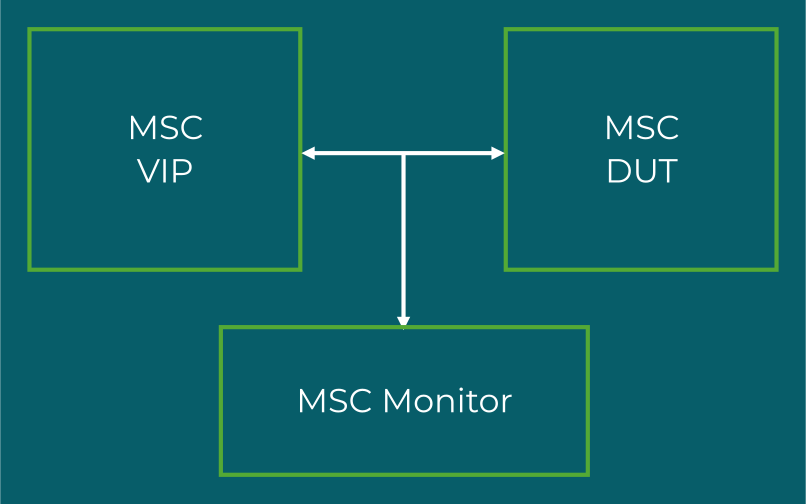
Microsecond Channel (MSC) VIP
Benefits
  • Full MSC Master and Device Support – Provides complete Microsecond Channel master and device component verification across the bidirectional high-speed synchronous downstream and low-speed asynchronous upstream interface, with support for TLE8888QK, TLE8718SA, and L9779WD automotive power management device configurations.
  • Transmission Mode Coverage – Supports triggered mode for on-demand downstream transmission and data repetition mode for periodic downstream data transfer, covering all defined MSC operational configurations across both single-device and multi-device bus topologies.
  • Downstream Frame Type Coverage – Supports all downstream transmission frame types including Command frames for device control and configuration and Data frames with and without SEL bit for payload data transfer across all connected MSC peripheral devices.
  • Upstream Frame Type Coverage – Supports all upstream asynchronous transmission frame types including 12-bit and 16-bit diagnostic response frames, parity error checking for upstream transmission integrity verification, and all defined baud divider rates of 4, 8, 16, 32, 64, 128, and 256 for upstream channel clock configuration.
  • Comprehensive Error Injection and Detection – Supports injection and detection of all defined MSC error types across both downstream and upstream channels, enabling thorough protocol violation and error recovery verification across all MSC transmission modes and frame configurations.
  • Complete Verification Infrastructure – Provides a full test suite covering all MSC specification features, built-in functional coverage analysis, protocol error and timing violation detection and notification, and status counters for bus events across all MSC operating conditions.
Compliance and Compatibility
  • Fully compliant with SAE Technical Paper 2005-01-0057 (Microsecond Bus MSC specification)
  • Supports TLE8888QK, TLE8718SA (Infineon) and L9779WD (STMicroelectronics) device configurations
  • Supports triggered and data repetition downstream transmission modes
  • Supports 12-bit and 16-bit upstream frame formats
  • Compatible with UVM, OVM, VMM, SystemVerilog, and Verilog verification environments
  • Compatible with all major EDA simulators including Synopsys VCS, Cadence Xcelium, Siemens Questa, Aldec Riviera-PRO, and Verilator

Request Datasheet