Contact Us
Overview

SmartDV’s MIPI RFFE Synthesizable Transactor is a fully featured RF Front-End Control Interface bus model purpose-built for hardware emulation and FPGA prototyping environments requiring fast, accurate, and highly configurable RFFE Main and Subordinate behavior during pre-silicon validation of 5G mobile, IoT, and RF front-end subsystem designs. Fully compliant with MIPI RFFE v3.2 and backward compatible with v2.1, v2.0, and v1.0, it delivers complete Main and Subordinate functionality with the flexibility to operate as Main, Subordinate, or both simultaneously, giving validation teams a drop-in synthesizable RFFE transactor ready for rapid integration into emulation and prototyping flows.

Designed for the speed and visibility demands of emulation and FPGA prototyping rather than ASIC tape-out, the transactor emphasizes fast bring-up, fine-grained controllability, and on-the-fly protocol checking over area or power optimization. It supports all RFFE frame types, Main ownership handover, extended register read/write, interrupt summary and identification command sequences, device enumeration, low power testing, half-speed operation, glitch injection and detection on both SDATA and SCLK at all positions, and comprehensive Main and Subordinate error generation, enabling validation teams to exercise corner-case RFFE behavior that is difficult to reach with production RTL alone.

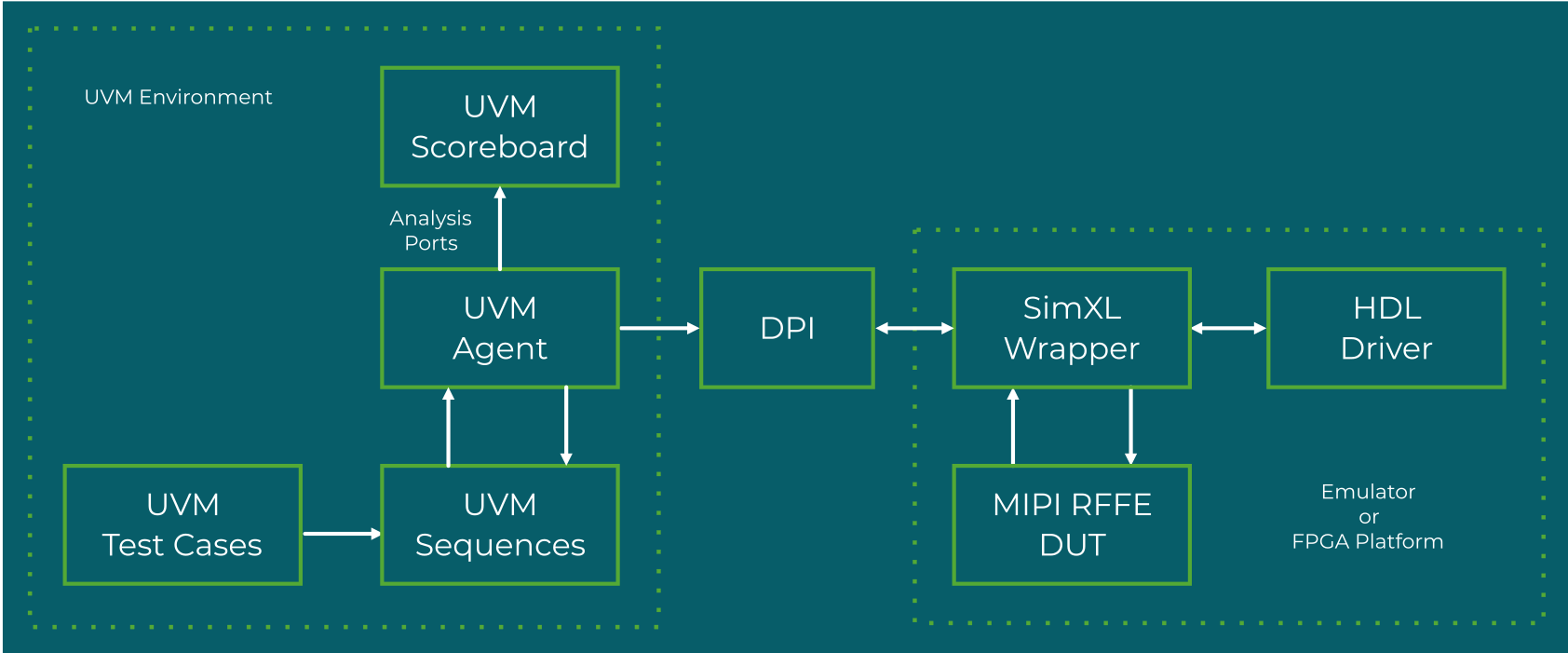
Built for fast compile times and efficient resource utilization on hardware emulation and FPGA prototyping platforms, the transactor is fully synthesizable and platform-independent, deploying without modification across any major emulation or prototyping environment. Its bus-accurate timing, complete testsuite covering every feature of the MIPI RFFE specification, and testbench notification of significant events, warnings, timing, and protocol violations enable rapid deployment for early software bring-up and RF front-end system-level validation regardless of the underlying emulation platform.
Request Data Sheet
MIPI RFFE Transactor
Key Features
  • Full MIPI RFFE Main and Subordinate Model – Complete Main and Subordinate behavior per MIPI RFFE v3.2 with flexibility to operate as Main, Subordinate, or both, supporting multiple subordinate devices and all standard RFFE topologies
  • Comprehensive Frame SupportCommand, Data/Address, No Response, Bus Ownership Transfer, Interrupt Polling, Main Write/Read, and Main Context Write/Read frames for complete RFFE protocol coverage
  • Main Ownership and Control – Main ownership handover, Main write and read sequences, extended register read/write, and interrupt summary and identification command sequences
  • Device Enumeration and Low PowerDevice enumeration support, low power testing, and half-speed operation for complete RFFE system bring-up validation
  • Glitch Injection and DetectionGlitch injection at all positions of SDATA and SCLK, plus glitch detection for comprehensive signal integrity and noise immunity validation
  • Comprehensive Error GenerationUndefined command frame, command frame parity and length errors, address frame parity error, data frame parity error, read/write of unused registers, broadcast ID and GSID read errors, and various Bus Ownership Transfer errors
  • Bus-Accurate Timing – Bus-accurate timing with status counters for various bus events for precise RFFE link validation
  • On-the-Fly Protocol CheckingReal-time protocol and data checking with testbench notification of significant events, warnings, timing, and protocol violations
  • Complete Test Suite – Comprehensive testsuite covering every feature of the MIPI RFFE specification for thorough out-of-the-box RF front-end validation
Compliance and Compatibility
  • Fully compliant with MIPI RFFE v3.2; backward compatible with RFFE v2.1, v2.0, and v1.0
  • Uses current MIPI Alliance terminology: Main (formerly Master) and Subordinate (formerly Slave)
  • Fully synthesizable and platform-independent, deployable on any hardware emulation or FPGA prototyping platform
  • Vendor-agnostic integration suitable for Synopsys, Cadence, Siemens, and custom emulation and prototyping environments
  • Configurable interface supporting integration into custom emulation and prototyping testbenches

Request Datasheet