Contact Us
Overview

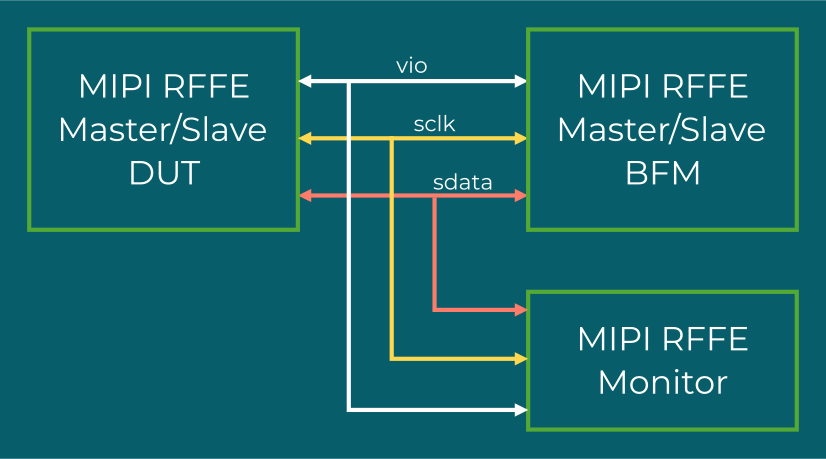
SmartDV’s MIPI RFFE Verification IP is a comprehensive solution for verifying the MIPI RF Front-End Control Interface, the world’s de facto standard two-wire control bus for managing complex RF front-end subsystems including power amplifiers, low-noise amplifiers, antenna tuners, filters, and switches in mobile and 5G devices. Fully compliant with MIPI RFFE v3.2 (December 2025) and backward compatible with v3.0, v2.1, v2.0, and v1.0, it supports complete verification of RFFE main and subordinate device components across all defined topologies, all frame types and command sequences, trigger and extended trigger modes, Timed and Mappable Triggers for 5G FR1 synchronization, Normal and Secondary operation modes, USID programming, interrupt handling, bus ownership transfer, and comprehensive error injection across all defined RFFE error types.

SmartDV’s MIPI RFFE VIP supports UVM, SystemVerilog, and Verilog, and integrates seamlessly into diverse verification environments. It is simulator-independent and compatible with all leading EDA simulators, providing flexibility across simulation platforms.

With comprehensive glitch injection and detection on both SDATA and SCLK, half-speed support, bus-accurate timing, bus clocked condition support, device enumeration, low power testing, built-in functional coverage, and a complete test suite, SmartDV’s MIPI RFFE VIP enables verification teams to thoroughly validate RF front-end control interface designs for 4G LTE, 5G NR, carrier aggregation, multi-transceiver, and dual-SIM mobile device RF subsystem applications.
Request Data Sheet
MIPI RFFE VIP
Key Features
  • Full RFFE Main and Subordinate Device Support – Provides complete MIPI RFFE main and subordinate device component verification across all defined topologies with multiple subordinate devices, supporting multi-main configuration, bus ownership transfer, master ownership handover, interrupt-capable subordinate devices, secondary master request, and half-speed operation, with the VIP configurable as main, subordinate, or both.
  • Comprehensive Frame and Command Sequence Coverage – Supports all RFFE frame types including Command Frame, Data/Address Frame, and No Response Frame, and all command sequences including master write and read, master context write and context read, extended register read/write, interrupt summary and identification, masked write, and silent main-initiated bus park.
  • 5G Trigger and Synchronization Support – Supports Trigger and Extended Trigger modes, Timed Triggers for tighter synchronized timing control of multiple carrier aggregation configurations, Mappable Triggers for remapping groups of control functions, Bus Clocked Condition, synchronous read, and all RFFE v3.0 enhancements designed for 5G FR1 sub-6 GHz cellular band requirements.
  • USID, Group Slave ID, and Device Enumeration – Supports USID Programming Procedures 1, 2, and 3, Group Slave ID configuration, device enumeration, Normal and Secondary operation modes, and interrupt polling for complete subordinate device identification and configuration verification.
  • Comprehensive Error Injection and Detection – Supports all defined RFFE error types including undefined command frame, command frame with parity error, command frame length error, address frame with parity error, data frame with parity error, read and write of unused registers, read using broadcast ID or GSID, and various bus ownership transfer errors, with read data comparison against expected results.
  • Glitch Injection and DetectionSupports injection of glitches at all positions of SDATA and SCLK signals, and detection of glitches across all bus signal conditions for comprehensive physical layer fault simulation.
  • Complete Verification Infrastructure – Provides a full test suite covering all MIPI RFFE v3.2 specification features, built-in functional coverage analysis, bus-accurate timing, status counters for bus events, and callbacks in main, subordinate, and monitor for user-defined event handling and protocol and timing violation notification.
Compliance and Compatibility
  • Fully compliant with MIPI RFFE v3.2 (December 2025); backward compatible with v3.1, v3.0, v2.1, v2.0, and v1.0
  • Supports all defined RFFE topologies with up to 15 subordinate devices and up to 4 main devices per bus instance
  • Supports 5G FR1 Timed and Mappable Trigger enhancements from RFFE v3.0
  • Compatible with UVM, OVM, VMM, SystemVerilog, and Verilog verification environments
  • Compatible with all major EDA simulators including Synopsys VCS, Cadence Xcelium, Siemens Questa, Aldec Riviera-PRO, and Verilator

Request Datasheet