Contact Us
Overview

SmartDV’s MIPI RFFE Slave IP is a silicon-proven, fully featured RF Front-End Control Interface solution purpose-built for RF front-end component designs requiring precise, deterministic control from an RFFE master in 5G mobile, IoT, automotive, and base station applications. Fully compliant with MIPI RFFE v3.2 and backward compatible with all prior RFFE generations, it delivers complete slave-side RFFE functionality with support for extended frequency operation up to 52 MHz, making it a high-performance choice for demanding 5G multi-band and carrier aggregation RF subsystem designs.

Designed to address the full breadth of modern RF slave device requirements, the IP supports Normal and Secondary operation modes, all three USID Programming Procedures, Group Slave ID, Timed and Mappable Triggers, Half-Speed Data Response, and a comprehensive error detection suite covering undefined commands, parity errors, frame length errors, and invalid register accesses. Its support for device enumeration, Broadcast Writes, and reserved register allocations in both basic and extended address spaces gives RF component teams a production-tested, spec-complete slave implementation that goes well beyond basic RFFE compliance.

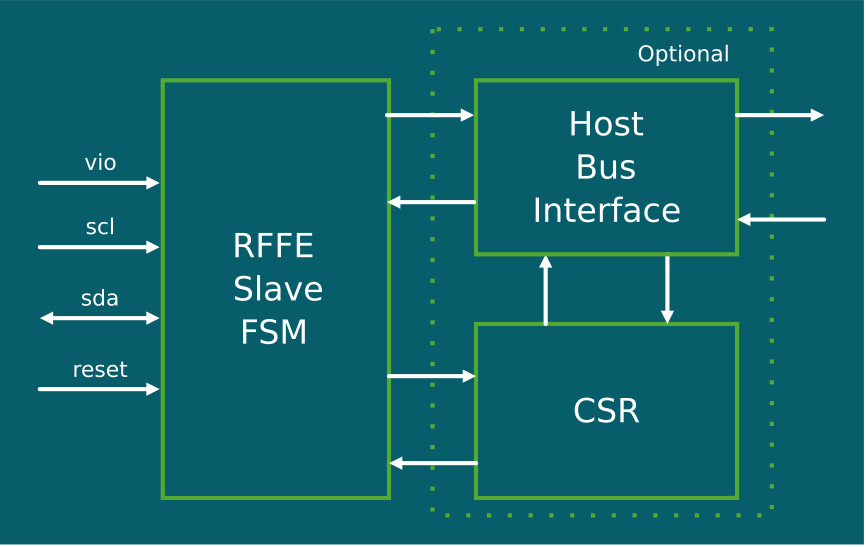
Built for design flexibility and silicon efficiency, the IP core is highly configurable for both ASIC and FPGA implementations, with a strong focus on area optimization, power management, and peak performance. Its parameterized architecture and clean host interface enable fast integration and confident design bring-up across a wide range of RF front-end process nodes and target applications.
Request Data Sheet
MIPI RFFE Slave
Benefits
  • Full MIPI RFFE Slave Functionality – Complete slave-side implementation per MIPI RFFE v3.2 including Command, Data/Address, and No Response frame support
  • Advanced Trigger Support – Trigger, Extended Trigger, Timed Trigger, and Mappable Trigger modes for precise, synchronized timing control in complex 5G carrier aggregation scenarios
  • Extended Frequency Range – Operation up to 52 MHz SCLK for high-speed RF front-end control in demanding 5G deployments
  • Flexible Operation Modes – Normal and Secondary operation modes with USID Programming Procedures 1, 2, and 3 and Group Slave ID support for versatile RF subsystem integration
  • Half-Speed Support – Half-Speed Data Response (HSDR) accesses and Full Command Sequence at Half-Speed SCLK for power-efficient RF control operation
  • Comprehensive Register Management – Broadcast Writes to PWR_MODE, TRIG_REG, EXT_TRIG_REG, Extended Register Read/Write, Delayed Read-back, and Reserved Register Allocations in both Basic (0x1C–0x1F) and Extended (0x20–0x3F) address spaces
  • Device Management – Device enumeration, PRODUCT_ID/MANUFACTURER_ID/USID read from reserved registers, PWR_MODE slave state read/write, and Interrupt Capable Slave support
  • Comprehensive Error Detection – Undefined command frames, parity errors on command/address/data frames, frame length errors, unused register access, and broadcast/GSID read error detection
Compliance and Compatibility
  • Fully compliant with MIPI RFFE v3.2; backward compatible with RFFE v3.0, v2.x, and v1.x
  • Configurable SoC interface supporting AMBA AXI, AHB, APB, and custom wrappers for seamless integration
  • Compatible with ASIC and FPGA design flows across leading foundry process nodes
  • Compatible with all major EDA synthesis, simulation, and linting flows

Request Datasheet