The problem is not that standardized IP is bad. Standard IP has a clear and valuable role in semiconductor development. It is often pre-verified, broadly compliant, and efficient for teams that need a proven foundation quickly.
The limitation is that standardized IP is usually designed for the middle of the market. If a design sits at the edge of what is possible in performance, power, or area, the middle of the market may not be where the design needs to be.
In many advanced designs, even small inefficiencies in IP, such as extra logic, unused features, or suboptimal configurations, can directly affect performance, power consumption, and silicon cost.
As semiconductor designs grow more complex, the gap is widening between what standardized IP delivers and what cutting-edge chips actually need. AI accelerators, edge computing devices, smart vehicles, AIoT hardware, wearables, and high-performance SoCs all demand stronger performance, lower power, and smaller silicon footprints. Standard IP blocks, built for broad compatibility, often cannot optimize all three at once.
That is why customizable IP, often referred to as custom IP or configurable IP, is no longer a nice-to-have. SoC IP customization is becoming a core part of how leading semiconductor teams compete.
The Limits of One-Size-Fits-All Standard IP
Standard IP Has Value, But It Can Create Design Friction
Standardized IP has real value. It can reduce development effort, accelerate integration, and provide a protocol-compliant starting point. For many applications, it is exactly the right choice.
But for teams pushing the boundaries of performance and efficiency, generic IP can create friction. It may carry features a design does not need, impose constraints the architecture did not ask for, or leave PPA, meaning power, performance, and area, optimization on the table.
When a team is designing for a specific workload, interface, system architecture, or power envelope, that overhead can add up quickly.
Where Customization Matters Most
The need for customization is especially important in areas where performance, power, and area tradeoffs are most critical. These may include memory interfaces, on-chip interconnects, high-speed connectivity protocols, automotive systems, AI accelerators, and specialized embedded designs.
Customization enables design teams to:
- Eliminate unnecessary features to reduce silicon area
- Optimize performance for targeted workloads
- Modify protocol configurations to suit specific system architectures
- Improve power efficiency
- Align IP capabilities with distinct product requirements
- Support reuse across product families or future design variants
For advanced SoC teams, this can be the difference between adapting the design around available IP and using IP that is adapted to the design.
Customization Is Harder Than It Looks
Custom IP Requires More Than Parameter Changes
The appeal of custom IP is easy to understand: tailor the implementation, remove unnecessary features, and hit the design target more precisely. In practice, customization is more complex.
Effective customization often goes beyond simple parameter changes. It may require architectural modifications, protocol adjustments, interface changes, feature reductions, and full re-verification. Any meaningful change to the IP must be validated to ensure functionality, compliance, performance, and reliability are maintained.
Real-World Customization Scenarios
Common customization scenarios may include:
- Changing an SoC bus interface, such as adapting communication between different AMBA-based interfaces
- Adding internal DMA functionality that requires new hardware design and verification of data paths
- Supporting protocol extensions or project-specific implementation requirements
- Reducing gate count by stripping IP down to essential functionality
- Optimizing IP for a specific power, performance, or area profile
- Adapting IP for reuse across related SoC, ASIC, or FPGA programs
In safety-critical domains such as automotive, aerospace, medical, and industrial systems, functional safety expectations can add another layer of complexity.
Custom IP done well requires deep protocol expertise, a rigorous development process, and verification infrastructure that can validate each modification with confidence.
SmartDV’s Answer: IP Your Way
IP Should Fit the Design
Customization is not a side offering at SmartDV. It is central to how the company approaches semiconductor IP.
The idea behind IP Your Way is straightforward: customers should not have to adapt their designs to fit available IP. The IP should fit the design.
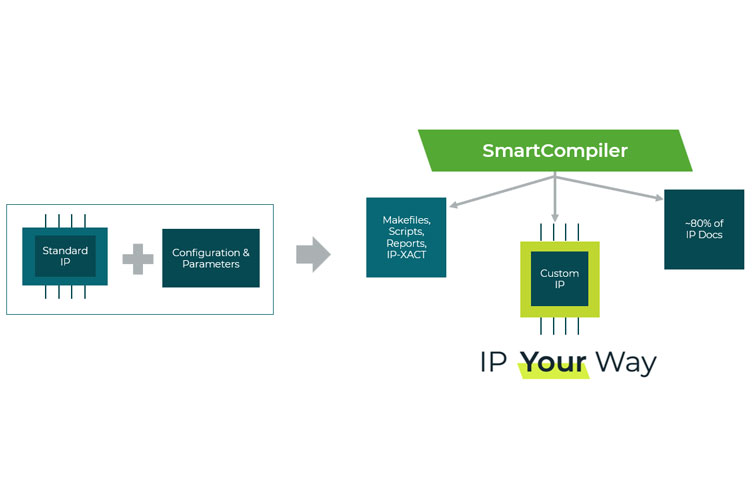
SmartDV brings together a broad portfolio of Design IP and Verification IP, along with deep engineering experience and a proprietary development platform called SmartCompiler™.
Customizable IP Built on a Proven Foundation
SmartDV’s approach allows teams to start from a proven, standards-based IP foundation and adapt it to meet specific project requirements. This helps reduce the tradeoff between speed and customization.
The result is customized IP that is designed to remain standards-compliant, production-ready, and aligned with each customer’s architecture, interface, verification, and product roadmap requirements.
SmartCompiler: The Engine Behind the Customization
Automating IP Development and Configuration
SmartCompiler™ supports the lifecycle of IP development, customization, and verification. Instead of manually modifying RTL for each requirement, SmartCompiler helps generate IP variants efficiently and consistently.
This allows SmartDV to configure IP for project-specific needs while maintaining a repeatable process for validation and delivery.
Why SmartCompiler Matters for Engineering Teams
SmartCompiler enables:
- Faster development cycles
- Reduced engineering overhead
- More consistent protocol compliance
- Optimized and repeatable IP generation
- Customization based on real project requirements
- A more scalable path for future IP variants
For teams building advanced SoCs, this helps reduce the risk that customization becomes slow, inconsistent, or difficult to verify.
How the SmartDV Customization Process Works
Start With the Right Foundation
SmartDV’s customization process begins with the right technical foundation. Customers can select from SmartDV’s portfolio of Design IP and Verification IP. Where needed, SmartDV can extend or adapt IP to meet specific design requirements.
This allows teams to avoid starting from scratch while still moving beyond rigid, one-size-fits-all implementations.
Define What the Design Actually Needs
Before customization begins, project requirements need to be defined clearly. This may include PPA targets, protocol requirements, interface specifications, feature needs, system constraints, safety considerations, and verification expectations.
Defining these requirements upfront helps ensure the final IP is optimized for the design rather than simply configured around default assumptions.
Customize, Verify, and Integrate
SmartDV engineers customize the IP using SmartCompiler and validate it through comprehensive verification methodologies. This is a critical part of the process because customized IP must still meet functional, protocol, and integration requirements.
For complex systems, SmartDV can also support pre-integration planning across related IP, controllers, interfaces, and verification environments.
Teams can explore SmartDV’s full Design IP and Verification IP portfolio to evaluate options for their architecture and verification needs.
Why Customizable IP Supports Long-Term SoC Strategy
Advanced Designs Are Becoming More Specialized
Emerging trends such as chiplet architectures, AI silicon, heterogeneous integration, advanced automotive systems, and edge computing are increasing demand for IP that can be adapted to specific architecture goals.
Generic IP often cannot meet the combined performance, power, area, and integration requirements of these systems. As designs become more specialized, customizable IP becomes a stronger differentiator.
Customization Supports Reuse Across Product Families
Customizable IP can also support long-term reuse. A team may need to use the same IP foundation across multiple products, but with different configurations, interfaces, features, or performance targets.
When IP is designed to be configurable from the beginning, it can be easier to adapt across product families and future platform revisions. This helps engineering teams build around a reusable foundation instead of restarting IP evaluation and integration for every new design.
Related SmartDV Products and Internal Resources
Custom IP, Design IP, and Verification IP
SmartDV provides customizable IP solutions for teams that need semiconductor IP aligned with specific architecture, protocol, verification, and product requirements.
Related SmartDV resources include:
- Custom IP
- Design IP
- Verification IP
- Flexible IP Licensing and Customizable IP: What SoC Teams Should Consider
Supporting Verification and Reuse Resources
For teams evaluating customization, verification, and long-term reuse together, these related resources may also be useful:
- What Is Verification IP and Why It Matters in Modern SoC Design
- How Reusable Verification IP Supports Scalable SoC Verification
- UVM Testbench Architecture & Verification IP Integration
Article Summary
Customizable IP is becoming essential for modern SoC design because advanced chips often require tighter alignment between IP functionality, architecture requirements, and PPA goals. Standard IP remains valuable, but it may not always provide the precision needed for specialized AI, automotive, edge, HPC, wearable, or heterogeneous SoC designs.
Custom IP allows engineering teams to remove unnecessary features, optimize performance, improve power efficiency, reduce area, adapt protocol behavior, and align IP more closely with project-specific requirements.
SmartDV’s IP Your Way approach, supported by SmartCompiler™, helps teams start from a proven standards-based IP foundation and customize it for real-world architecture, integration, verification, and product roadmap needs.
Frequently Asked Questions
What is custom IP in semiconductor design?
Custom IP refers to Design IP or Verification IP that is modified or built to meet specific system requirements. Unlike standard IP, it can be optimized for performance, power, area, protocol behavior, interface needs, and architectural constraints.
How is customizable IP different from standard IP?
Standard IP is built for broad compatibility, while customizable IP is tailored to a specific design. Custom IP can remove unnecessary features, improve efficiency, and align more closely with the exact requirements of an SoC, ASIC, or FPGA project.
Why is PPA optimization important in SoC design?
PPA stands for power, performance, and area. These three factors directly affect chip efficiency, cost, speed, energy use, and silicon footprint. Optimizing PPA is especially important in modern applications such as AI accelerators, edge devices, automotive systems, and wearable technology.
When should a design team choose custom IP?
A design team should consider custom IP when standard IP cannot meet performance, power, area, interface, safety, or architectural requirements. Custom IP is especially valuable for specialized SoCs, high-performance systems, and products with strict efficiency or integration goals.
Does custom IP require additional verification?
Yes. Any meaningful customization, including architectural changes, feature modifications, or protocol adjustments, requires verification to ensure functionality, compliance, reliability, and integration quality are maintained.
Explore SmartDV Custom IP Solutions
As designs become more specialized, customizable IP is becoming a key differentiator in chip development. SmartDV helps teams stop working around IP that does not fit and start with IP built for their architecture, optimized for their PPA, and aligned with their verification requirements.
Explore SmartDV’s Custom IP solutions, browse Design IP, review Verification IP, or contact SmartDV to discuss your project requirements.