Contact Us
Overview

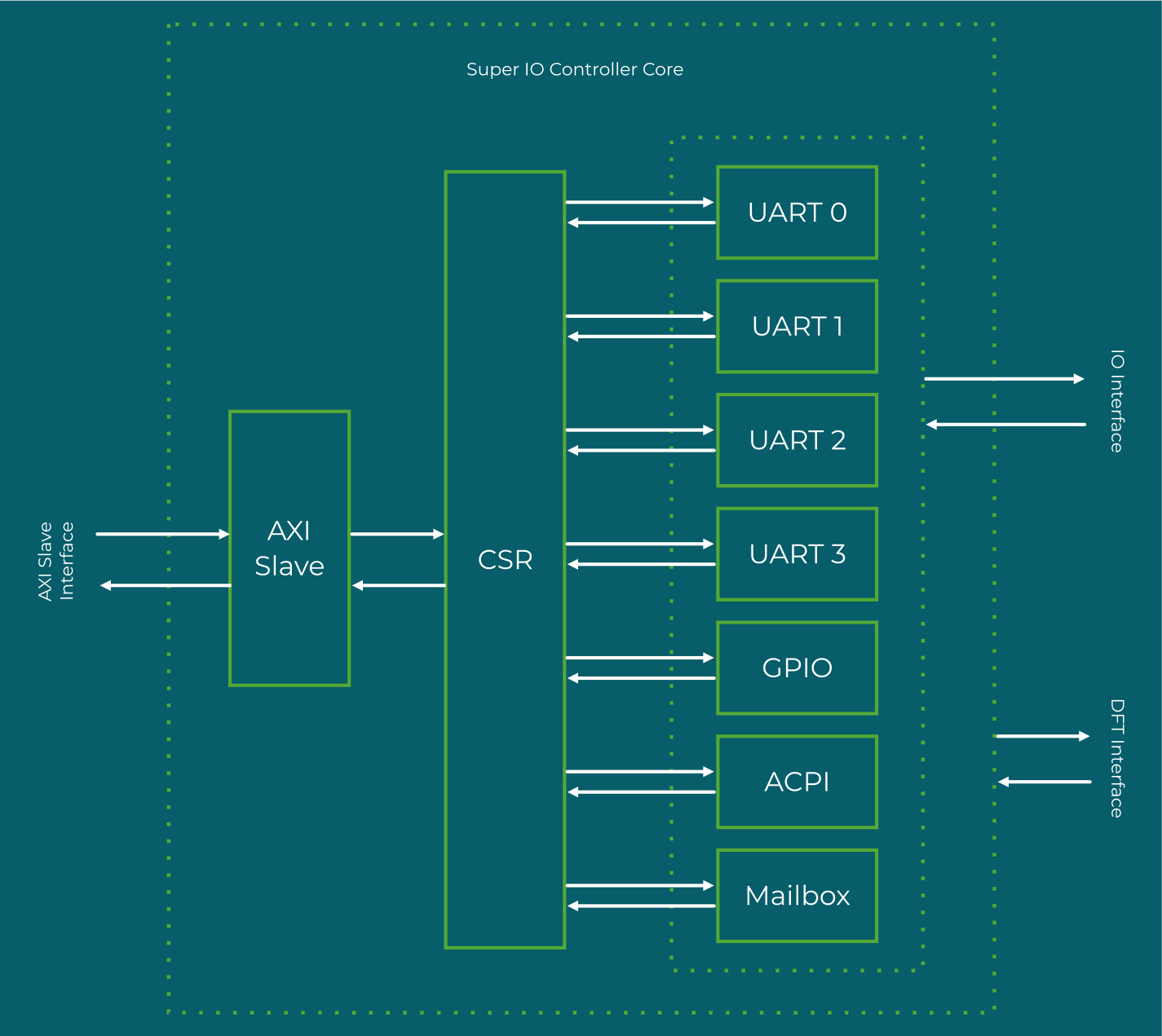
SmartDV’s Super IO IP is a silicon-proven, fully integrated Super Input/Output controller solution purpose-built for SoC designs requiring a comprehensive set of legacy and modern peripheral functions in a single, unified IP core. Supporting seven logical devices corresponding to seven individual functions — UART, GPIO, Mailbox, and SWC/ACPI — it delivers a complete Super IO implementation for server, embedded computing, industrial, and automotive SoC designs requiring host-to-SoC messaging, legacy serial communication, power management, and GPIO control within a single integration-ready peripheral controller.

Designed to address the full breadth of Super IO integration requirements, the IP combines a UART 16550-compatible serial controller supporting baud rates from 1800 bps to 3.686 Mbps with a comprehensive GPIO subsystem, a 32-register Mailbox for bidirectional host-to-SoC messaging, and a complete SWC/ACPI power management controller supporting SMI, SCI, SerIRQ, S3/S5 power states, programmable wake-up events, and plug-and-play register sets. Its seven independent logical devices, interrupt controller, configurable FIFOs, and comprehensive status and control registers give SoC teams a production-tested, feature-complete Super IO implementation that eliminates the need for multiple discrete peripheral controllers.

Built for design flexibility and silicon efficiency, the IP core is highly configurable for both ASIC and FPGA implementations, with a strong focus on area optimization, power management, and peak performance. Its parameterized architecture and clean host interface enable fast integration and confident design bring-up across a wide range of process nodes and target applications.
Request Data Sheet
Super IO
Key Features
  • Seven Logical Device Support – Seven independent logical devices for UART, GPIO, Mailbox, and SWC/ACPI functions with host-to-SoC messaging and configurable interrupt thresholds
  • Full UART 16550 Functionality – Complete UART implementation per NS16550A standard with Character Mode, FIFO Mode, and Extended FIFO Mode supporting 5 to 8 data bits, 1 to 2 stop bits, and programmable baud rates from 1800 bps to 3.686 Mbps
  • Modem Control and Error Detection – Full modem control interface with CTS, RTS, DSR, DTR, RI, and DCD signals, programmable hardware flow control, and parity, framing, and overflow error detection with line break detection and generation
  • GPIO with Port 80h/81h Redirect – Port 80h/81h redirect to two GPIO groups and Serial GPIO Port1/Port2 for LED indicator support
  • 32-Register Mailbox – 32 general purpose mailbox registers per node with full transmit and receive functionality, maskable interrupts, configurable FIFOs, and threshold-based interrupt generation
  • Complete ACPI/SWC Power Management – SMI, SCI, SerIRQ, S3 and S5 power state support, programmable wake-up events, plug-and-play register set, power supply control, and power button GPIO control
  • Comprehensive Interrupt Management – Independent interrupt controller across all logical devices with configurable thresholds and maskable interrupt support
Compliance and Compatibility
  • Fully compliant with UART NS16550A de-facto standard
  • Compliant with ACPI v6.6 specification (May 2025) for SWC power management functionality
  • Compatible with industry-standard Super IO logical device architecture
  • Configurable SoC interface supporting AMBA AXI, AHB, APB, and custom wrappers for seamless integration
  • Compatible with ASIC and FPGA design flows across leading foundry process nodes
  • Compatible with all major EDA synthesis, simulation, and linting flows

Request Datasheet