Contact Us
Overview

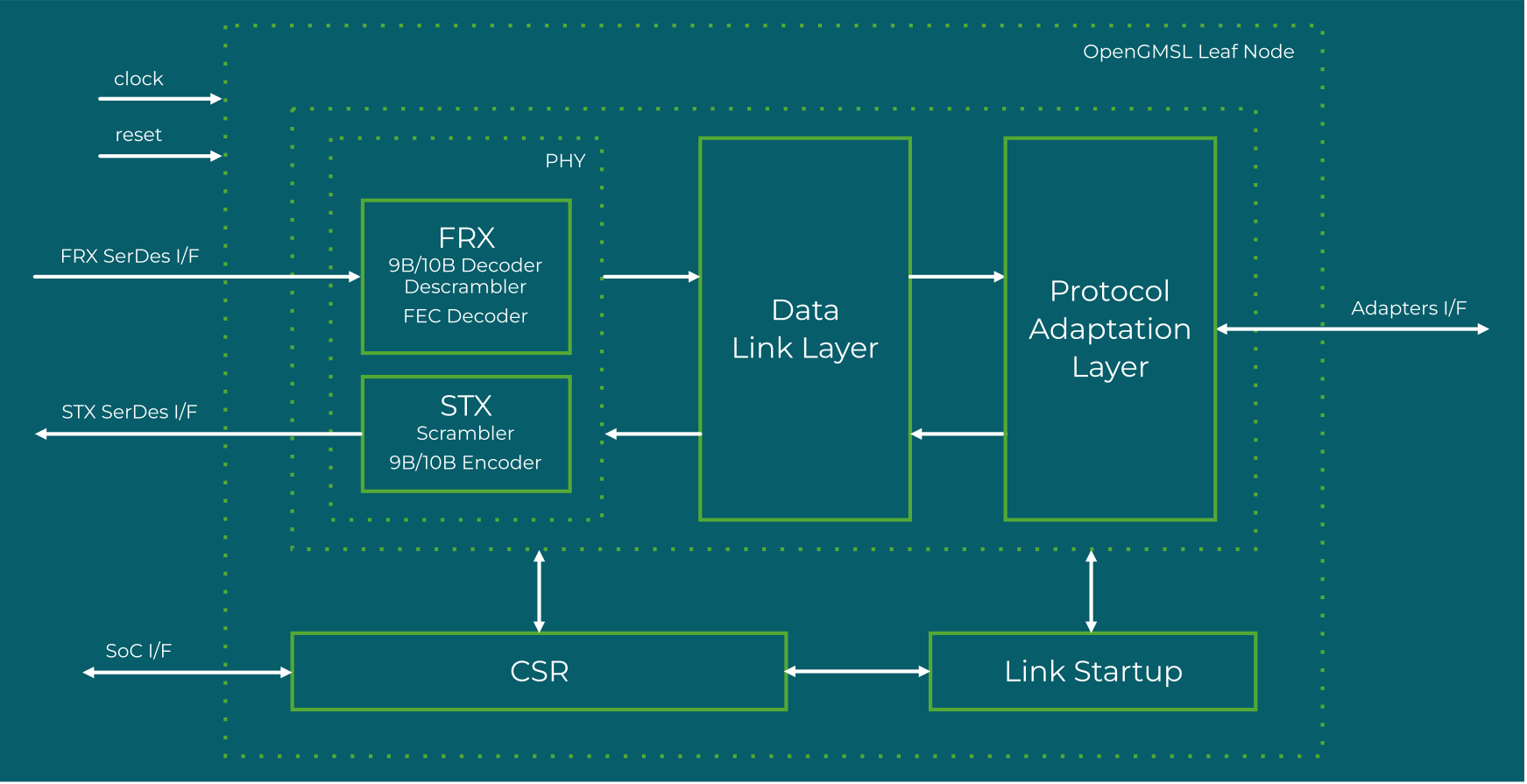
SmartDV’s OpenGMSL Leaf IP is a fully featured Gigabit Multimedia Serial Link deserializer solution purpose-built for automotive SoC designs requiring reliable, high-bandwidth edge-side connectivity between sensors, cameras, and displays and zonal compute nodes across ADAS, autonomous driving, and in-vehicle infotainment applications. Fully compliant with OpenGMSL v3.0, it delivers complete Leaf (deserializer) functionality supporting forward link data rates up to 12 Gbps and reverse link rates of 187.5 Mbps, with comprehensive support for video streaming, bidirectional sideband data, functional safety, and HDCP content protection, providing a feature-complete OpenGMSL Leaf implementation for next-generation software-defined vehicle architectures.

As automotive E/E architectures evolve toward zonal compute designs with centralized processing and distributed sensor networks, OpenGMSL v3.0 provides the open, multi-vendor interoperable SerDes standard needed to connect edge sensors and displays to central compute nodes. SmartDV’s OpenGMSL Leaf IP implements the complete deserializer feature set including RS-FEC (127,121) forward error correction, 9B/10B decoding, descrambling, Precision Time Synchronization, HDCP v1.4 and v2.3 content protection, and functional safety mechanisms, giving automotive SoC teams a spec-complete, future-ready Leaf implementation that delivers the reliability and interoperability demanded by next-generation ADAS and autonomous driving designs.

Built for design flexibility and silicon efficiency, the IP core is highly configurable for both ASIC and FPGA implementations, with a strong focus on area optimization, power management, and peak performance. Its programmable SERDES interface widths, flexible link topology support, and clean host interface enable fast integration and confident design bring-up across a wide range of automotive process nodes and target applications.
Request Data Sheet
OpenGMSL Leaf
Benefits
  • Full OpenGMSL Leaf Functionality – Complete deserializer implementation per OpenGMSL v3.0 supporting forward link rates of 3 Gbps (Link Rate 1), 6 Gbps (Link Rate 2 NRZ and Link Rate 3 PAM4), and 12 Gbps (Link Rate 4) with 187.5 Mbps reverse link
  • Comprehensive Video Format Support – RGB 4:4:4 (16/18/24/30/36 bpp), YUV 4:2:2 (16/20 bpp), YCbCr 4:2:2 (16/20 bpp), YCbCr 4:2:0 (16/20 bpp), RAW (8/10/12/14/16/20 bpp), and Byte-based (8 bpp)
  • Full-Duplex Multi-Stream Support – Unidirectional video/sensor streams and bidirectional data for Ethernet, SPI, I2C, UART, I2S/TDM audio, PDM audio, GPIO streams, and infoframes
  • RS-FEC Forward Error Correction – RS-FEC (127,121) decoder for forward link reception for reliable high-speed automotive SerDes operation
  • Advanced Signal Processing – 9B/10B decoder and descrambler for forward link and 9B/10B encoder and scrambler for reverse link operation
  • Flexible SERDES Interface – Programmable parallel SERDES widths of 20, 40, and 80 bits for forward link and 10-bit for reverse link operation
  • Flexible Link Topology – Splitter, aggregation, and daisy-chain link topology support with standard and fast link startup
  • Precision Time Synchronization – PTS support and Reference over Reverse (RoR) clock generation for root node synchronization
  • Content Protection – HDCP v1.4 and v2.3 encryption and decryption for video and audio stream protection
  • Functional Safety – FuSa mechanisms per OpenGMSL v3.0 for ASIL-rated automotive safety applications
  • Power Management – Sleep and Standby low power state support for power-efficient automotive edge node operation
Compliance and Compatibility
  • Fully compliant with OpenGMSL v3.0 specification (March 2026)
  • Compatible with ADI GMSL2 and GMSL3 technology implementations
  • Optional support for HDCP v1.4 and HDCP v2.3 content protection
  • Configurable SoC interface supporting AMBA AXI, AHB, APB, and custom wrappers for seamless integration
  • Compatible with ASIC and FPGA design flows across leading foundry process nodes
  • Compatible with all major EDA synthesis, simulation, and linting flows

Request Datasheet