Contact Us
Overview

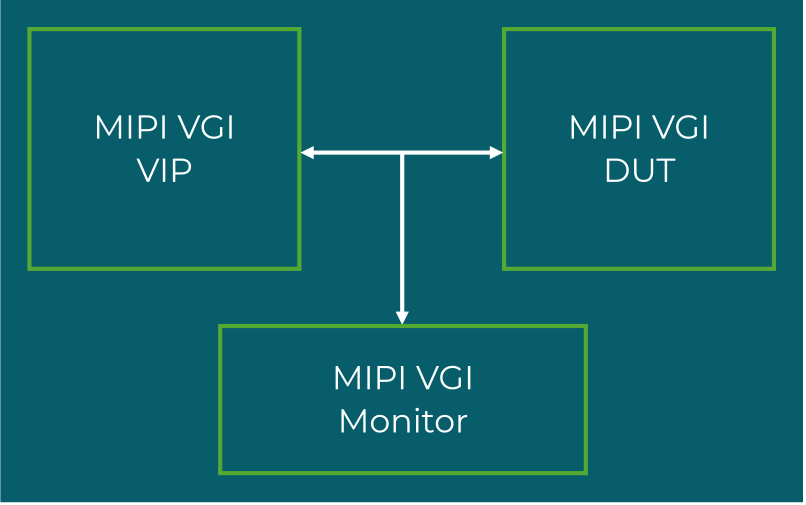
SmartDV’s MIPI VGI Verification IP is a comprehensive solution for verifying the MIPI Virtual GPIO Interface, a point-to-point full-duplex serial interface designed to consolidate multiple sideband GPIOs and low-speed messaging connections between mobile SoC application processors and peripheral devices over a 2-wire or 3-wire interface. Based on the MIPI VGI draft specification developed by the MIPI Reduced I/O Working Group, it supports complete verification of VGI Host and Peripheral components across 2-wire asynchronous and 3-wire synchronous interface configurations, vGPIO logic-state exchange and messaging exchange communication categories, all three synchronous gear rates, in-band flow control, in-band hard reset, and comprehensive error injection and detection.

SmartDV’s MIPI VGI VIP supports UVM, SystemVerilog, and Verilog, and integrates seamlessly into diverse verification environments. It is simulator-independent and compatible with all leading EDA simulators, providing flexibility across simulation platforms.

With serializer and deserializer support, configurable clock frequencies up to 78 MHz, default 2-wire PWM signaling, bus-accurate timing, built-in functional coverage, and a complete test suite, SmartDV’s MIPI VGI VIP enables verification teams to thoroughly validate virtual GPIO interface designs for smartphones, tablets, IoT devices, and mobile-influenced systems requiring pin-count reduction through GPIO and messaging consolidation.
Request Data Sheet
Benefits
  • Full VGI Host and Peripheral Support – Provides complete MIPI VGI Host and Peripheral component verification across point-to-point full-duplex communication, supporting 2-wire asynchronous and 3-wire synchronous interface configurations, serializer and deserializer functionality, default 2-wire PWM signaling, and bus-accurate timing.
  • Communication Category Coverage – Supports both defined VGI communication categories including vGPIO logic-state exchange for serialized GPIO state transfer between host and peripheral, and messaging exchange for low-speed inter-processor communication, across both serial stream and message stream frame structures.
  • Comprehensive Data Rate and Gear Coverage – Supports asynchronous 2-wire operation at up to 4 Mbps, and synchronous 3-wire operation across all three defined gear rates including Gear-1 at 32 KHz to 26 MHz, Gear-2 at 32 KHz to 52 MHz, and Gear-3 at 32 KHz to 78 MHz, covering the complete VGI device class range.
  • Flow Control and Reset Support – Supports in-band flow control for managing data transfer rates between host and peripheral, in-band hard reset for deterministic interface initialization, transmission latency within permissible limits, and all defined VGI protocol state machine transitions.
  • Comprehensive Error Injection and Detection – Supports insertion and detection of all defined VGI error types across both 2-wire asynchronous and 3-wire synchronous interface configurations for thorough protocol violation verification.
  • Complete Verification Infrastructure – Provides a full test suite covering all MIPI VGI draft specification features, built-in functional coverage analysis, and protocol error and timing violation detection and notification across all VGI operating conditions.
Compliance and Compatibility
  • Based on MIPI VGI draft specification (MIPI Reduced I/O Working Group)
  • Supports 2-wire asynchronous (up to 4 Mbps) and 3-wire synchronous (up to 78 MHz) interface configurations
  • Supports vGPIO logic-state exchange and messaging exchange communication categories
  • Compatible with UVM, OVM, VMM, SystemVerilog, and Verilog verification environments
  • Compatible with all major EDA simulators including Synopsys VCS, Cadence Xcelium, Siemens Questa, Aldec Riviera-PRO, and Verilator

Request Datasheet