Contact Us
Overview

SmartDV’s MIPI Debug Over I3C Verification IP is a comprehensive solution for verifying the MIPI Debug Over I3C interface, a bare-metal, minimal-pin debug and trace interface for transporting debug controls and data between a Debug and Test System and a Target System over the MIPI I3C bus. Fully compliant with MIPI Debug Over I3C v1.1 (May 2024) and based on MIPI I3C v1.1.1, it supports complete verification of DTS controller and TS device components across dedicated debug and shared bus topologies, covering full I3C slave operation with Hot Join, IBI, DAA, and HDR modes, complete link and network/transport layer functionality, up to 16 network adaptors, all Debug Common Command Codes, Debug Network Adaptor Operation Commands, and Debug In-Band Interrupts.

SmartDV’s MIPI Debug Over I3C VIP supports UVM, SystemVerilog, and Verilog, and integrates seamlessly into diverse verification environments. It is simulator-independent and compatible with all leading EDA simulators, providing flexibility across simulation platforms.

With support for SPP, STP, SAM, TWP, and UART network adaptors, group addressing for multicast debug transfers, timing control with message timestamps, all defined DBGOPCODE and DBGACTION commands, comprehensive IBI cause coverage, built-in functional coverage, and a complete test suite, SmartDV’s MIPI Debug Over I3C VIP enables verification teams to thoroughly validate debug interface designs for mobile SoCs, IoT devices, automotive ECUs, and any power-managed multi-component system requiring scalable dynamic debug connectivity.
Request Data Sheet
MIPI Debug VIP
Key Features
  • Full DTS Controller and TS Device Support – Provides complete Debug and Test System controller and Target System device component verification across dedicated debug and shared I3C bus topologies, supporting full I3C slave operation with Hot Join, In-Band Interrupt, Dynamic Address Assignment, and HDR mode as introduced in MIPI Debug Over I3C v1.1, and up to 16 network adaptors per bus.
  • Network Adaptor Coverage – Supports all defined MIPI debug network adaptors including SPP (SneakPeek Protocol), STP (System Trace Protocol), SAM (System Awareness Module), TWP (Trace Wrapper Protocol), and UART, covering complete link and network/transport layer functionality for all supported debug and trace data streams.
  • Debug Common Command Code Coverage – Supports all Debug Common Command Codes covering network adaptor management and system debug control, including all DBGOPCODE commands: CAPABILITIES, CFG, START_NA, STOP_NA, FIFO_THRESHOLD, FIFO_ACTION, SELECT, and REPORT_ERROR opcodes.
  • Debug Action Command CoverageSupports all Debug Action Commands including DBGRST for debug reset, STARTSET and EXECSET actions for programmed debug sequence execution, covering complete debug control plane verification across all supported Target System configurations.
  • Debug In-Band Interrupt SupportSupports all defined Debug In-Band Interrupt cause types including DBGSTATUS for debug status notification, DBGDATAREADY for data availability signaling, and DBGERROR for error notification, enabling complete interrupt-driven debug flow verification.
  • Advanced v1.1 Feature SupportSupports HDR mode operation for high-speed debug data transfer, group addressing for simultaneous multicast transfers to multiple Target System devices, timing control with timestamps applied to messages and interrupts, and MIPI I3C v1.1.1 baseline features for enhanced efficiency and performance.
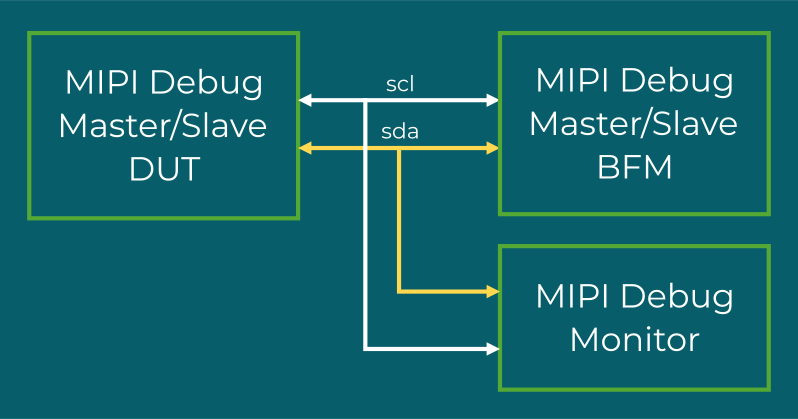
  • Complete Verification Infrastructure – Provides a full test suite covering all MIPI Debug Over I3C v1.1 specification features, built-in functional coverage analysis, and callbacks in Master, Slave, and Monitor for user-defined data processing and protocol and timing violation notification.

Compliance and Compatibility
  • Fully compliant with MIPI Debug Over I3C v1.1 (May 2024); backward compatible with v1.0.1 and v1.0
  • Based on MIPI I3C v1.1.1 with full HDR mode support
  • Supports up to 16 network adaptors across SPP, STP, SAM, TWP, and UART adaptor types
  • Compatible with UVM, OVM, VMM, SystemVerilog, and Verilog verification environments
  • Compatible with all major EDA simulators including Synopsys VCS, Cadence Xcelium, Siemens Questa, Aldec Riviera-PRO, and Verilator

Request Datasheet