Contact Us
Overview

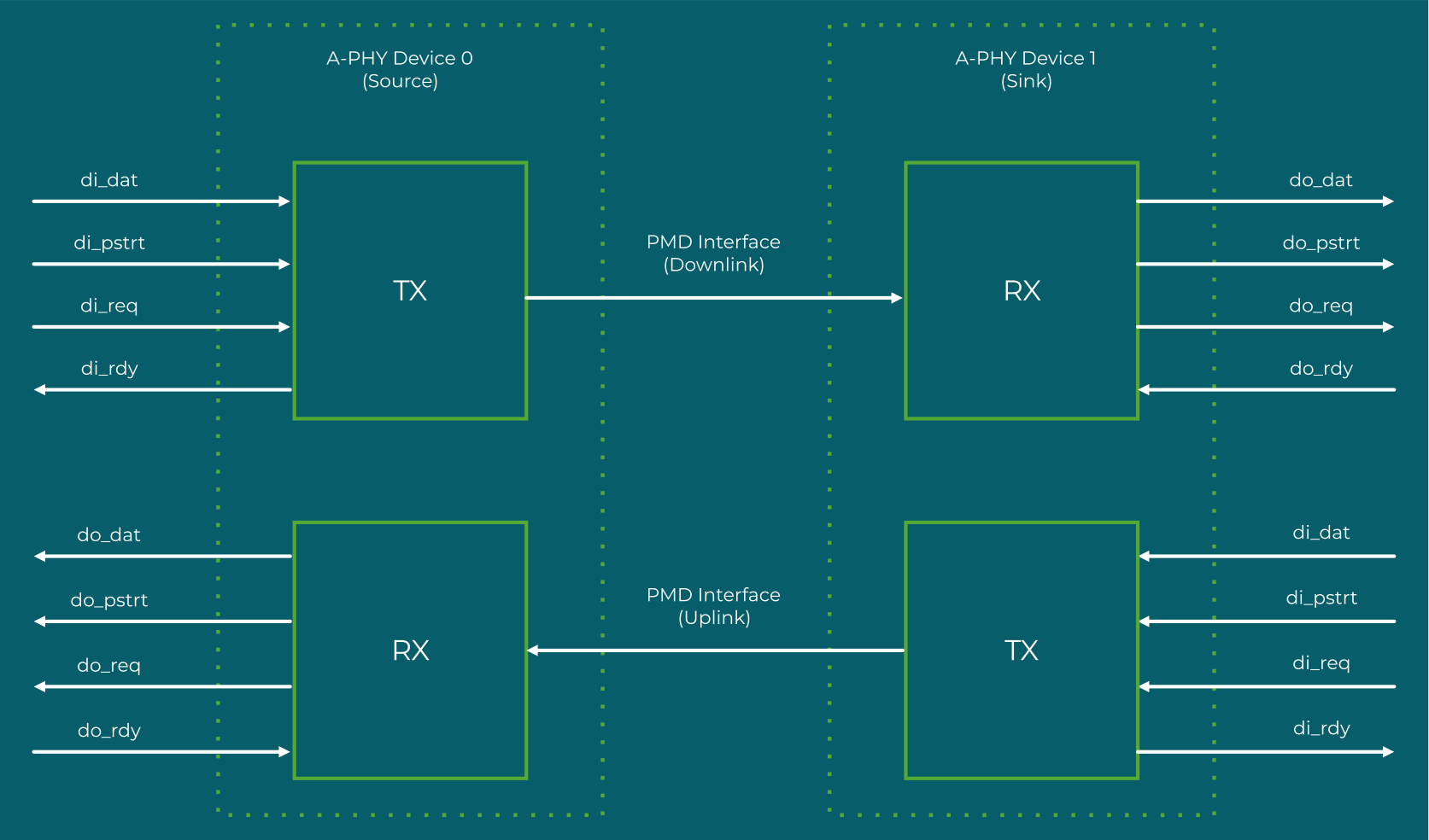
SmartDV’s MIPI A-PHY PCS IP is a silicon-proven, high-performance automotive SerDes physical coding sublayer solution engineered for next-generation SoC designs requiring ultra-high-speed, long-reach serial connectivity between image sensors, displays, and electronic control units. Fully compliant with MIPI A-PHY v2.0 and backward compatible with v1.1 and v1.0, it delivers downlink data rates up to 32 Gbps per lane across single and dual lane configurations, making it a strategic choice for ADAS, autonomous driving, digital cockpit, and in-vehicle infotainment applications.

As automotive E/E architectures evolve toward zonal designs and software-defined vehicles, the demand for high-bandwidth, deterministic, long-reach SerDes interfaces has never been greater. SmartDV’s A-PHY PCS IP addresses this with comprehensive support for both NRZ and PAM4/8/16 modulation profiles, dual startup modes, advanced clock recovery, and a complete PHY and Data Link layer implementation, giving automotive SoC teams a future-ready, spec-complete A-PHY solution without the complexity of building it from scratch.

Built for design flexibility and silicon efficiency, the IP core is highly configurable for both ASIC and FPGA implementations, with a strong focus on area optimization, power management, and peak performance. Its parameterized architecture, support for multiple speed gears and modulation profiles, and clean APPI interface enable fast integration and confident design bring-up across a wide range of automotive process nodes and target applications.
Request Data Sheet
MIPI A-PHY PCS
Key Features
  • Full MIPI A-PHY PHY and Data Link Layer Support – Complete PCS implementation covering PHY layer architecture and Data Link layer functions including link service, local, multi-port, and network functions
  • Multi-Gear Speed Support – Seven downlink speed gears from 2 Gbps to 32 Gbps (G1 to G7) and uplink gears at 100 Mbps (U1), 200 Mbps (U2), and 1.6 Gbps (U3) per A-PHY v2.0
  • Dual Modulation Profile Support – Profile 1 (NRZ, 8B/10B) and Profile 2 (PAM4, PAM8, PAM16) for flexible, application-specific physical layer implementation
  • Advanced Clock Recovery – Sink transmitter uses recovered source clock to generate proper sink transmit clock for accurate port rate synchronization
  • Dual Startup Mode Support – Mission Mode and Unidirectional startup procedures for flexible link initialization across different deployment scenarios
  • Comprehensive Link Reliability – Retransmission request and ACK support, scrambler per specification, re-training sequence, and Repetitive Scrambler Reset Test (RSRT) mode
  • Power Management – Wake-Up protocol with Non-Active and Active mode support for power-efficient automotive operation
  • Single and Dual Lane Support – Point-to-point serial communication in single and dual lane configurations for flexible bandwidth and redundancy options
Compliance and Compatibility
  • Fully compliant with MIPI A-PHY v2.0; backward compatible with MIPI A-PHY v1.1 and v1.0
  • Also compliant with IEEE 2977-2021 (A-PHY v1.0)
  • Configurable SoC interface supporting APPI and custom wrappers for seamless integration
  • Compatible with ASIC and FPGA design flows across leading foundry process nodes
  • Compatible with all major EDA synthesis, simulation, and linting flows

Request Datasheet