Contact Us
Overview

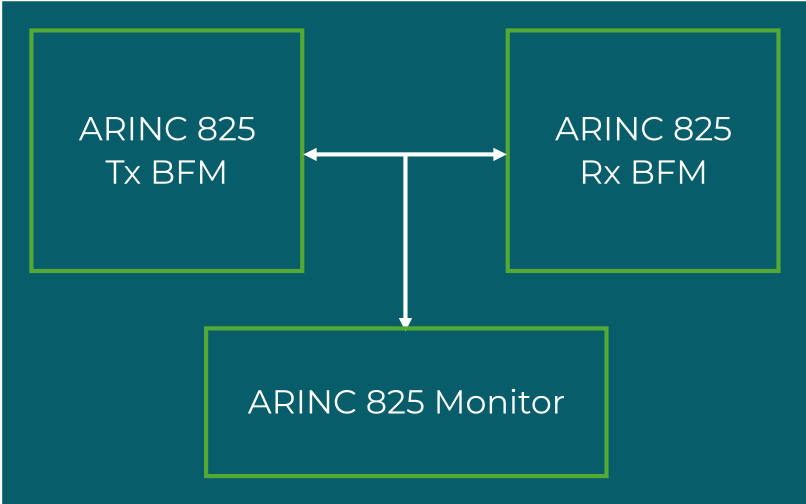
SmartDV’s ARINC 825 Verification IP is a comprehensive solution for verifying the Controller Area Network bus protocol standard for airborne use, covering CAN and CAN Flexible Data Rate communication for current and future commercial aircraft applications. Fully compliant with ARINC Specification 825-4 and backward compatible with earlier revisions, it supports complete verification of ARINC 825 nodes across all defined data rates, all four CAN frame types, all nine node service interfaces, and the full PHSM identifier structure, with one-to-many and peer-to-peer communication modes.

SmartDV’s ARINC 825 VIP supports UVM, SystemVerilog, and Verilog, and integrates seamlessly into diverse verification environments. It is simulator-independent and compatible with all leading EDA simulators, providing flexibility across simulation platforms.

With comprehensive error injection and detection across all five CAN error types, TEC/REC error counter and fault state tracking, bit-by-bit arbitration, glitch injection, automatic remote frame handling, built-in functional coverage, and a complete test suite, SmartDV’s ARINC 825 VIP enables verification teams to thoroughly validate airborne CAN bus designs for commercial aviation, defense, and aerospace applications.
Request Data Sheet
ARINC 825 VIP
Benefits
  • Full CAN Node Support – Supports complete ARINC 825 node operation with one-to-many and peer-to-peer communication modes, PHSM identifier structure, broadcast and acknowledgement by all nodes, bit-by-bit arbitration, and a rich set of configuration parameters for fine-grain protocol control.
  • All Data Rate and Frame Type Coverage – Supports all five defined data rates including 83.33 Kbit/s, 125 Kbit/s, 250 Kbit/s, 500 Kbit/s, and 1 Mbit/s, and all four CAN frame types including Data, Remote, Error, and Overload frames, with CAN FD support for data transfer rates up to 4 Mbps as introduced in ARINC 825-4.
  • Comprehensive Node Service Interface Support – Covers all nine ARINC 825 node service interfaces including Node Service Concept, Node Identification Service, Node Synchronization Service, Data Upload Service, Data Download Service, Bit Control Service, Non-Volatile Storage Service, Node-ID Setting Service, and Service Control Service.
  • Remote Frame Handling – Supports automatic transmission after reception of a Remote Transmission Request, automatic reception after transmission of an RTR, and complete remote frame request and response verification across all configured node types.
  • Comprehensive Error Injection and Detection – Supports all five CAN error types including bit errors, stuff errors, CRC errors, format errors, and acknowledgement errors, with TEC and REC error counter tracking, fault state monitoring, glitch injection and detection, and automatic re-transmission of corrupted messages.
  • Complete Verification Infrastructure – Provides built-in functional coverage analysis, constraints randomization, status counters for bus events, and callbacks in transmitter, receiver, and monitor for user-defined event handling and protocol and timing violation notification.
Compliance and Compatibility
  • Fully compliant with ARINC Specification 825-4; backward compatible with ARINC 825-3, 825-2, and 825-1
  • Supports CAN FD (CAN Flexible Data Rate) as defined in ARINC 825-4
  • Compatible with UVM, OVM, VMM, SystemVerilog, and Verilog verification environments
  • Compatible with all major EDA simulators including Synopsys VCS, Cadence Xcelium, Siemens Questa, Aldec Riviera-PRO, and Verilator

Request Datasheet