Contact Us
Overview

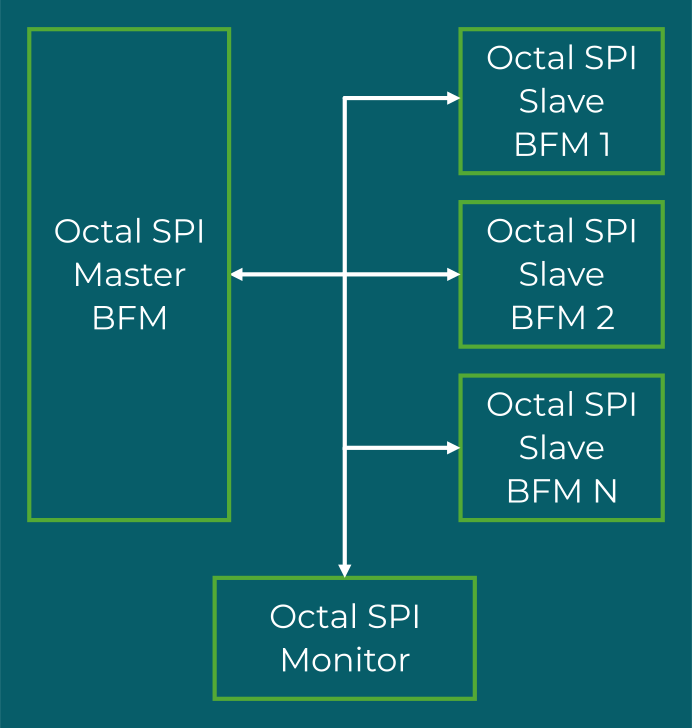
SmartDV’s Octal SPI Verification IP is a comprehensive solution for verifying the eXpanded Serial Peripheral Interface for NOR flash memory devices, providing high data throughput octal I/O serial flash verification for embedded, automotive, IoT, and edge AI applications requiring fast code execute-in-place and high-bandwidth data storage. Fully compliant with JEDEC JESD251 (xSPI) and the Macronix MXSMIO Octal SPI device specification, it supports complete verification of Octal SPI master and slave components across Single I/O (SPI) and Octa I/O (OPI) modes, Double Transfer Rate mode, 1-byte SPI and 2-byte OPI command formats, serial and burst transfer modes, advanced block and sector protection, 8K-bit OTP security, SFDP, electronic identification, and command reset across the full 11-wire slave interface.

SmartDV’s Octal SPI VIP supports UVM, SystemVerilog, and Verilog, and integrates seamlessly into diverse verification environments. It is simulator-independent and compatible with all leading EDA simulators, providing flexibility across simulation platforms.

With configurable baud rate selection, backdoor data initialization, FIFO-based slave configuration, rich master command set, constraints randomization, built-in functional coverage, and a complete test suite, SmartDV’s Octal SPI VIP enables verification teams to thoroughly validate Octal SPI flash memory interface designs for automotive ADAS and infotainment, IoT gateways, industrial controllers, edge AI inference platforms, and any embedded system requiring high-bandwidth serial NOR flash connectivity.
Request Data Sheet
Octal SPI VIP
Key Features
  • Full Octal SPI Master and Slave Support – Provides complete Octal SPI master and slave component verification across the 11-wire slave interface, supporting data width up to 8 bits, configurable baud rate selection, single and burst transfer modes, FIFO-based slave configuration for flexible data passing, and a rich master command set covering both standard device and FIFO model modes.
  • Single I/O and Octa I/O Mode Coverage – Supports Single I/O (SPI) mode with 1-byte command code format at up to 133 MHz and Octa I/O (OPI) mode with 2-byte command code format at up to 133 MHz, covering all defined SPI Mode 0 protocol transfers across both SDR and DTR configurations.
  • Double Transfer Rate Mode SupportSupports DTR Double Transfer Rate mode for both Single I/O and Octa I/O configurations, doubling effective data throughput by transferring data on both rising and falling clock edges, enabling verification of high-bandwidth octal flash access patterns for XIP and data storage applications.
  • Advanced Security Feature Coverage – Supports block lock protection for flexible memory region locking, Advanced Sector Protection covering Solid Protect and Password Protect modes, and 8K-bit one-time-programmable security area with unique identifier support, factory-locked identifiable area, and customer-lockable area for complete flash security verification.
  • Device Discovery and Identification – Supports Serial Flash Discoverable Parameters mode for JEDEC JESD216-compliant device capability discovery, electronic identification including JEDEC 1-byte manufacturer ID and 2-byte device ID, and command reset for deterministic device initialization.
  • Complete Verification Infrastructure – Provides built-in functional coverage analysis, constraints randomization, backdoor initialization of data for memory preloading, status counters for bus events, and callbacks in master, slave, and monitor for user-defined event handling and protocol and timing violation notification.
Compliance and Compatibility
  • Fully compliant with JEDEC JESD251 (xSPI eXpanded Serial Peripheral Interface) and JESD251D
  • Compliant with Macronix MXSMIO Octal SPI device specification
  • Supports JEDEC JESD216 Serial Flash Discoverable Parameters (SFDP)
  • Supports Single I/O (SPI) and Octa I/O (OPI) modes with DTR at up to 133 MHz
  • Compatible with UVM, OVM, VMM, SystemVerilog, and Verilog verification environments
  • Compatible with all major EDA simulators including Synopsys VCS, Cadence Xcelium, Siemens Questa, Aldec Riviera-PRO, and Verilator

Request Datasheet