Contact Us
Overview

SmartDV’s LPDDR3 Verification IP is a comprehensive solution for verifying Low Power Double Data Rate 3 memory interfaces, the high-bandwidth, power-efficient DRAM standard widely deployed in smartphones, tablets, ultra-thin notebooks, and mobile computing devices. Fully compliant with JEDEC JESD209-3C and backward compatible with JESD209-3B and JESD209-3, it supports complete verification of LPDDR3 device components across x16 and x32 device configurations with densities up to 32 GB, covering all defined commands, mode register programming, write leveling, ZQ calibration, CA training, DQ calibration, ODT, power down, deep power down, and all timing delay ranges in both full-timing and behavioral models.

SmartDV’s LPDDR3 VIP supports UVM, SystemVerilog, and Verilog, and integrates seamlessly into diverse verification environments. It is simulator-independent and compatible with all leading EDA simulators, providing flexibility across simulation platforms.

With bus-accurate timing for minimum, typical, and maximum delay ranges in a single model, comprehensive power management feature coverage, write data mask and data strobe verification, input clock stop and frequency change, built-in functional coverage, and a complete test suite, SmartDV’s LPDDR3 VIP enables verification teams to thoroughly validate LPDDR3 memory interface designs for mobile SoCs, application processors, automotive infotainment, and power-sensitive embedded computing applications.
Request Data Sheet
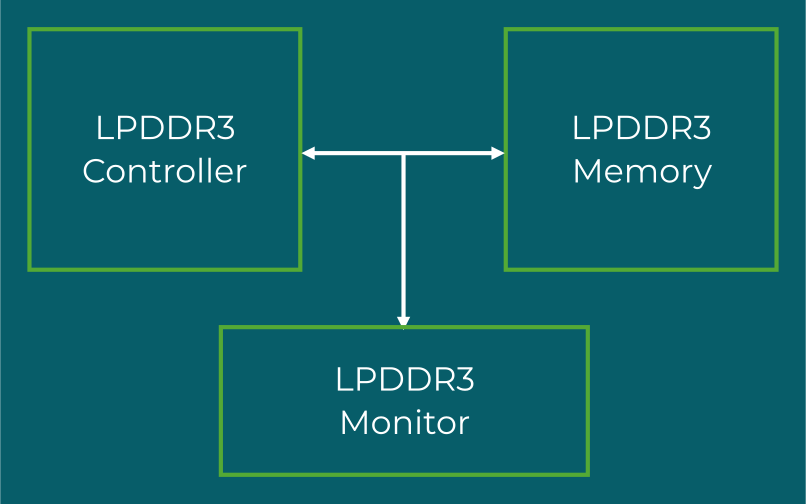
LPDDR3 VIP
Key Features
  • Complete LPDDR3 Device Protocol Coverage – Supports 100% of the LPDDR3 protocol standard across JESD209-3C, JESD209-3B, and JESD209-3, all LPDDR3 commands, x16 and x32 device configurations, densities up to 32 GB, all defined data rates as per specification, and programmable READ/WRITE latency timings.
  • Comprehensive Training and Calibration Support – Covers write leveling, ZQ calibration, CA training, DQ calibration, and ODT on-die termination, enabling complete interface training and calibration sequence verification across all LPDDR3 operating modes.
  • Power Management Feature CoverageSupports power down, deep power down, input clock stop and frequency change, write data mask and data strobe features, and all defined LPDDR3 low power operating states for complete power management verification.
  • Full-Timing and Behavioral ModelProvides full-timing and behavioral versions in a single model with all timing delay ranges — minimum, typical, and maximum — covering burst sequence verification and all defined LPDDR3 timing parameters.
  • Comprehensive Protocol CheckingProvides continuous monitoring of LPDDR3 device behavior during simulation covering power-up, initialization, power-off rules, state-based rules, active command rules, read and write command rules, and all timing violations, with protocol checker fully compliant with JESD209-3C.
  • Complete Verification Infrastructure – Provides built-in functional coverage analysis, constraints randomization, all mode register programming support, and callbacks for user access to monitor-observed data across all LPDDR3 protocol conditions.
Compliance and Compatibility
  • Fully compliant with JEDEC JESD209-3C (LPDDR3); backward compatible with JESD209-3B and JESD209-3
  • Supports x16 and x32 device configurations with densities up to 32 GB
  • Supports full-timing and behavioral models with minimum, typical, and maximum delay ranges
  • Compatible with UVM, OVM, VMM, SystemVerilog, and Verilog verification environments
  • Compatible with all major EDA simulators including Synopsys VCS, Cadence Xcelium, Siemens Questa, Aldec Riviera-PRO, and Verilator

Request Datasheet