Contact Us
Overview

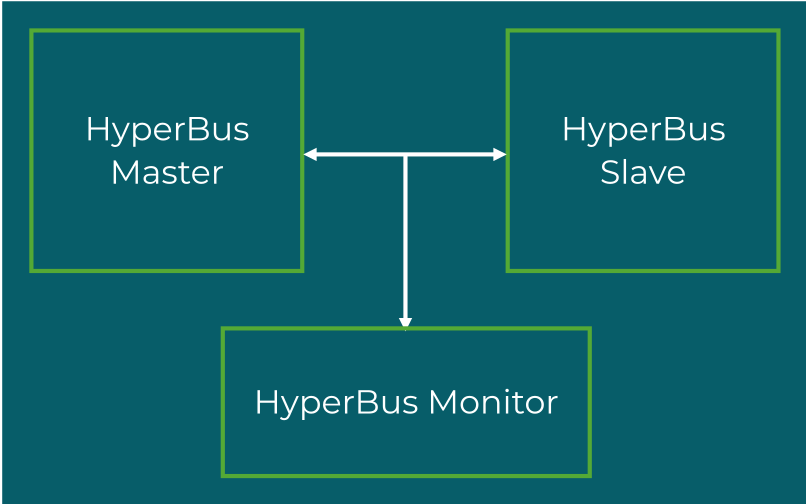
SmartDV’s HyperBus Verification IP is a comprehensive solution for verifying the HyperBus low signal count, high-performance DDR bus interface for connecting microprocessors, microcontrollers, and ASICs with HyperFlash NOR flash memory and HyperRAM DRAM devices. Fully compliant with the Infineon HyperBus Specification (formerly Cypress HyperBus Specification), it supports complete verification of HyperBus master and slave interfaces across the 8-bit DQ data bus with Read-Write Data Strobe, covering all HyperFlash and HyperRAM commands, all configurable burst characteristics, all power conservation modes, and comprehensive HyperFlash-specific features including sector erase, advanced sector protection, ECC, and CRC.

SmartDV’s HyperBus VIP supports UVM, SystemVerilog, and Verilog, and integrates seamlessly into diverse verification environments. It is simulator-independent and compatible with all leading EDA simulators, providing flexibility across simulation platforms.

With comprehensive burst configuration coverage including wrapped, linear, and hybrid burst modes, device identification and configuration register access, double data rate operation, hardware reset support, bus-accurate timing, built-in functional coverage, and a complete test suite, SmartDV’s HyperBus VIP enables verification teams to thoroughly validate HyperBus interface designs for automotive, industrial automation, IoT, networking, and embedded systems requiring high-performance code-execution-in-place and data storage.
Request Data Sheet
HyperBus VIP
Key Features
  • Full HyperBus Master and Slave Support – Supports complete HyperBus master and slave interface verification across the 8-bit DQ[7:0] data bus with Read-Write Data Strobe, Double Data Rate operation with two data transfers per clock, hardware reset support, device identification registers, and configuration register access.
  • Comprehensive Burst Configuration Support – Covers all configurable burst characteristics including wrapped burst lengths of 16 bytes (8 clocks), 32 bytes (16 clocks), 64 bytes (32 clocks), and 128 bytes (64 clocks), linear burst, and hybrid burst mode combining one wrapped burst followed by linear burst, with wrapped or linear burst type selectable per transaction.
  • HyperFlash Device Support – Supports complete HyperFlash verification including 512-byte program buffer, uniform 256-kB sector erase, optional eight 4-kB parameter sectors totaling 32 kB, advanced sector protection with volatile and non-volatile protection methods per sector, separate 1024-byte one-time program array, ECC with 1-bit correction and 2-bit detection, and CRC check-value calculation.
  • HyperRAM Device Support – Supports complete HyperRAM device verification including sequential burst transactions, configurable burst characteristics, configurable output drive strength, and all HyperRAM commands as per the Infineon HyperBus specification.
  • Power Conservation Mode Support – Covers Interface Standby, Active Clock Stop, and Deep Power-Down power conservation modes for complete power state verification across all HyperBus operating configurations.
  • Comprehensive Protocol Checking – Provides continuous monitoring of HyperBus behavior during simulation, covering power-up, initialization, power-off rules, state-based rules, and all timing violations, with protocol checker fully compliant with the Infineon HyperBus specification.
  • Complete Verification Infrastructure – Provides built-in functional coverage analysis, constraints randomization, and callbacks for user access to monitor-observed data across all HyperBus protocol conditions.
Compliance and Compatibility
  • Fully compliant with Infineon HyperBus Specification (Document 001-99253, formerly Cypress HyperBus Specification)
  • Supports HyperFlash NOR Flash and HyperRAM DRAM device types
  • Compatible with UVM, OVM, VMM, SystemVerilog, and Verilog verification environments
  • Compatible with all major EDA simulators including Synopsys VCS, Cadence Xcelium, Siemens Questa, Aldec Riviera-PRO, and Verilator

Request Datasheet