Contact Us
Overview

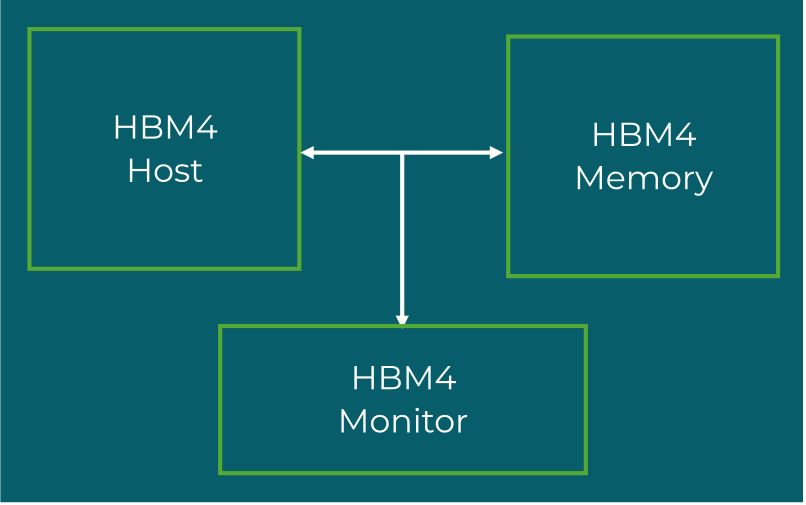
SmartDV’s HBM4 Verification IP is a comprehensive solution for verifying High Bandwidth Memory 4 interfaces, delivering up to 2 TB/s per stack across a 2048-bit interface for the most demanding AI training, HPC, and data center memory bandwidth requirements. Fully compliant with JEDEC JESD270-4 (updated December 2025) and backward compatible with HBM3 controllers, it supports complete verification of HBM4 device components across up to 32 channels per device with 2 pseudo-channels per channel, 24 Gb to 32 Gb layer densities supporting 4-high to 16-high stack configurations up to 64 GB per stack, covering pseudo-channel mode operation with 32 DQ width, semi-independent row and column command interfaces, 1KB page size per pseudo-channel, Directed Refresh Management, command and address parity, data parity, DBIac, WDQS-to-CK training, and IEEE 1500 standard test access.

SmartDV’s HBM4 VIP supports UVM, SystemVerilog, and Verilog, and integrates seamlessly into diverse verification environments. It is simulator-independent and compatible with all leading EDA simulators, providing flexibility across simulation platforms.

With comprehensive bank group support, Directed Refresh Management for row-hammer mitigation, enhanced RAS features, flexible voltage configuration, HBM3 controller backward compatibility, bus-accurate timing for all delay ranges, built-in functional coverage, and a complete test suite, SmartDV’s HBM4 VIP enables verification teams to thoroughly validate HBM4 memory interface designs for next-generation AI training accelerators, Nvidia Rubin and AMD MI400-class GPUs, hyperscale data centers, and bandwidth-intensive HPC applications.
Request Data Sheet
HBM4 VIP
Benefits
  • Full HBM4 Device Support – Supports complete HBM4 device verification per JEDEC JESD270-4 across up to 32 channels per device with 2 pseudo-channels per channel, 64 DQ width with optional ECC pin support per channel, 24 Gb to 32 Gb layer densities supporting 4-high to 16-high stack configurations up to 64 GB per stack, programmable clock frequency of operation, and all HBM4 commands as per specification.
  • Pseudo-Channel Mode and Semi-Independent Interface – Supports pseudo-channel mode operation with 32 DQ width per pseudo-channel, 2 pseudo-channels per channel, semi-independent row and column command interfaces, and 1KB page size per pseudo-channel for improved concurrency and reduced contention.
  • Bank Group and Timing Support – Supports bank grouping with 16, 32, 48, and 64 banks per channel based on device density and channel configuration, programmable READ/WRITE latency timings, burst length 8, DBIac write and read, WDQS-to-CK training, and bus-accurate timing for minimum, maximum, and typical values.
  • Directed Refresh Management and RAS – Supports Directed Refresh Management for enhanced row-hammer mitigation, command and address parity, data parity, write data strobe features, and comprehensive RAS verification including reliability, availability, and serviceability features as defined in JESD270-4.
  • HBM3 Controller Backward Compatibility – Supports backward compatibility with existing HBM3 controllers enabling a single controller to operate with both HBM3 and HBM4, flexible vendor-specific voltage configurations including VDDQ at 0.7V, 0.75V, 0.8V, or 0.9V and VDDC at 1.0V or 1.05V.
  • Power Management – Supports self-refresh modes, power down features, and input clock stop and frequency change for complete power state verification across all HBM4 operating configurations.
  • IEEE 1500 and Protocol Checking – Supports IEEE standard 1500 test access, continuous bus-accurate monitoring covering power-on, initialization, power-off rules, state-based rules, active command rules, read and write command rules, and all timing violations, with protocol checker fully compliant with JESD270-4.
  • Complete Verification Infrastructure – Provides built-in functional coverage analysis, constraints randomization, and callbacks for user access to command data and monitor-observed data across all HBM4 protocol conditions.
Compliance and Compatibility
  • Fully compliant with JEDEC JESD270-4 (HBM4, updated December 2025)
  • Backward compatible with HBM3 controllers per JESD270-4 compatibility specification
  • Supports up to 32 channels per device with 2 pseudo-channels per channel
  • Supports 4-high to 16-high stack configurations with 24 Gb to 32 Gb die densities up to 64 GB per stack
  • Compatible with UVM, OVM, VMM, SystemVerilog, and Verilog verification environments
  • Compatible with all major EDA simulators including Synopsys VCS, Cadence Xcelium, Siemens Questa, Aldec Riviera-PRO, and Verilator

Request Datasheet