Contact Us
Overview

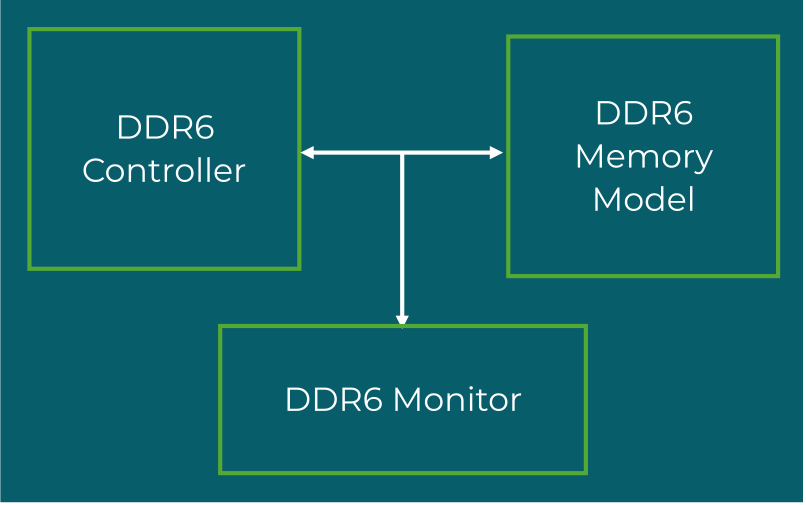
SmartDV’s DDR6 Verification IP is a comprehensive early-access solution for verifying next-generation DDR6 SDRAM memory interfaces, enabling design and verification teams to begin DDR6 validation ahead of JEDEC final ratification. Developed in alignment with the JEDEC DDR6 draft specification targeting data rates from 8,800 MT/s to 17,600 MT/s and featuring a quad 24-bit sub-channel architecture, it supports complete verification of DDR6 device components across x4, x8, and x16 device widths with densities up to 64 GB and 64 banks on die, covering all DDR6 commands, refresh management, Post Package Repair, and all timing delay ranges as defined in the current draft specification.

SmartDV’s DDR6 VIP supports UVM, SystemVerilog, and Verilog, and integrates seamlessly into diverse verification environments. It is simulator-independent and compatible with all leading EDA simulators, providing flexibility across simulation platforms.

With comprehensive refresh management verification including ARFM, DRFM, and PASR, advanced Post Package Repair coverage including hard, soft, and MBIST PPR, MRUPD mode support, bus-accurate timing for all timing delay ranges, built-in functional coverage, and a complete test suite, SmartDV’s DDR6 VIP enables verification teams to begin thorough DDR6 memory interface validation for next-generation AI, data center, server, and high-performance computing applications ahead of final spec ratification.
Request Data Sheet
DDR6 VIP
Benefits
  • Complete DDR6 Device Protocol Coverage – Supports 100% of the DDR6 draft specification across all DDR6 commands, x4, x8, and x16 device widths, densities up to 64 GB, 64 banks on die, all speed grades as per draft specification, programmable burst lengths of 8, 16, and 32, sequential burst type and burst order, and all timing delay ranges — minimum, typical, and maximum — in one model.
  • Comprehensive DDR6 Feature Support – Covers all mode register programming, write data mask, CRC for write, read, and MRR operations, DLL features, MRUPD mode as per draft specification, synchronous and asynchronous On-Die Termination, maximum power saving mode, self refresh and power down operation, self refresh entry with frequency change, and input clock stop and frequency change.
  • Advanced Refresh Management – Supports all DDR6 refresh modes and global refresh counter, Refresh Management All command and Same Bank command, Adaptive Refresh Management (ARFM), Directed Refresh Management (DRFM), Partial Array Self Refresh (PASR), self refresh entry with frequency change, and temperature compensated refresh reporting for comprehensive refresh subsystem verification.
  • Comprehensive Post Package Repair Support – Covers hard Post Package Repair (hPPR), soft Post Package Repair (sPPR), and Memory Built-In Self-Test Post Package Repair (mPPR) for thorough repair mechanism verification across all DDR6 device configurations.
  • Robust Protocol Checking and Monitoring – Provides continuous monitoring of DDR6 behavior during simulation, comprehensive timing and protocol violation detection covering power up, initialization, power off, state-based rules, active command rules, read and write command rules, and all timing violations, with protocol checker compliance to the current JEDEC DDR6 draft specification.
  • Complete Verification Infrastructure – Provides built-in functional coverage analysis, all timing delay ranges in a single model, and callbacks for user access to monitor-observed data across all DDR6 protocol conditions.
Compliance and Compatibility
  • Developed in alignment with the JEDEC DDR6 draft specification; will be updated upon final JEDEC ratification
  • Compatible with UVM, OVM, VMM, SystemVerilog, and Verilog verification environments
  • Compatible with all major EDA simulators including Synopsys VCS, Cadence Xcelium, Siemens Questa, Aldec Riviera-PRO, and Verilator

Request Datasheet